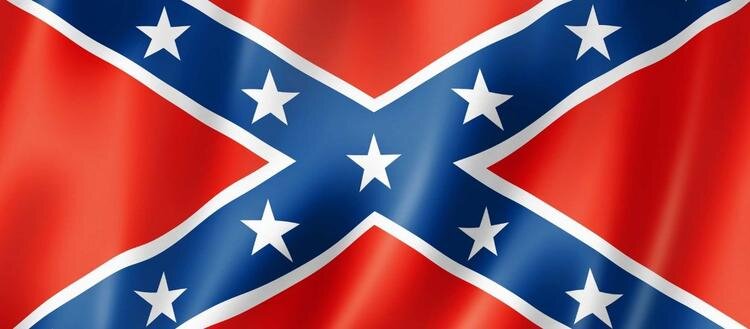

The Confederate flag most people picture is the battle flag of the Army of Northern Virginia. It shows a red field crossed by a blue saltire with 13 white stars.
This design never served as the official national flag of the Confederacy. Three different national flags flew from 1861 to 1865. Each one failed on the battlefield or in public use.
Today the battle flag divides Americans. A 2020 Quinnipiac poll found 56 percent of U.S. adults call it a symbol of racism while 35 percent call it Southern pride. Among Southerners the split was 55 percent racism and 36 percent pride.
Modern display of the Confederate battle flag
A 2024 Public Religion Research Institute poll showed 81 percent of Republicans support keeping Confederate symbols compared to 30 percent of Democrats. White Americans backed preservation at 58 percent while Black Americans stood at 25 percent.
These numbers explain the tension. The flag started as a battlefield tool in 1861. It later became a segregation symbol in the 1940s and 1950s. Its meaning shifted again after 2015.
The 3 Official Confederate National Flags vs. the Battle Flag
The Confederacy changed its national flag three times. None looked like the battle flag you see today.
First national flag (1861–1863): Stars and Bars. It had three horizontal stripes—red, white, red—with a blue canton holding seven white stars. Soldiers confused it with the U.S. flag during the First Battle of Manassas.
Second national flag (1863–1865): Stainless Banner. A white field with the battle flag in the canton. It looked too much like a surrender flag.
Third national flag (March 1865): Blood-Stained Banner. Added a red vertical stripe to fix the white-field problem. It saw almost no use before the war ended.
The battle flag itself came from William Porcher Miles. The Army of Northern Virginia adopted it in November 1861. A naval version stayed rectangular with a lighter blue cross.
Comparison Table (visual summary):
- Stars and Bars: 3 stripes + blue canton (7–13 stars)
- Stainless Banner: White field + battle flag canton
- Blood-Stained Banner: White field + red stripe + battle flag canton
- Battle Flag (today’s symbol): Red field + blue X + 13 stars
This table clears up the most common mix-up right away.

Confederate battle flag, flown around US South, AP explains
Civil War Purpose: Battlefield Tool, Not National Symbol
The battle flag solved a real problem. At Manassas in 1861 the Stars and Bars looked too similar to the U.S. flag in smoke and distance.
Robert E. Lee’s army needed a clear identifier. The blue saltire on red stood out. It carried no official national status.
The Confederacy’s Constitution protected slavery. Primary records show that link. The flag itself flew for military identification only.
Key battles where it appeared: First Manassas, Antietam, Gettysburg. It marked troop positions, not political headquarters.
Post-War Reinvention: From Veterans’ Memorial to Segregation Tool
After 1865 the flag faded for decades. United Confederate Veterans groups revived it in the 1890s for memorial parades.
By the 1930s it appeared at monument dedications across the South. It stayed mostly a veterans’ symbol until the 1940s.
20th Century Explosion: Dixiecrats, Civil Rights, and Pop Culture
The real shift hit in 1948. The Dixiecrat Party used the battle flag at rallies to oppose civil rights.
In 1956 Georgia added the battle flag to its state flag after the Brown v. Board decision. Mississippi followed in 1894 but kept the design through the 1960s.
Pop culture kept it visible. “The Dukes of Hazzard” car flew it in the 1980s. At the same time the KKK used it at rallies.
Public opinion stayed split. A 2000 CNN poll showed most whites saw Southern pride while most Black Americans saw racism. That pattern held until 2015.
21st Century Reality Check: Removals, Bans, and 2026 Status
The Charleston church shooting in 2015 changed everything. South Carolina removed the flag from its State House grounds that year.
2020 brought more action. Mississippi changed its state flag. NASCAR banned the flag at events. The Department of Defense restricted it on military bases.
As of 2026 private display on your own property remains protected speech. Public buildings, schools, and VA cemeteries face limits.
In February 2026 a South Carolina court ordered a large interstate flag removed after years of legal battles.
Some states allow temporary educational use. A 2025 Utah bill permitted Confederate flags in classrooms for history lessons while banning Pride flags.
Heritage vs. Hate: Facts, Polls, and Both Sides
Supporters point to ancestor commemoration. Sons of Confederate Veterans argue it honors soldiers who fought for home.
Opponents cite its post-1948 use in segregation campaigns. Historians link it to the Lost Cause narrative that downplayed slavery.
Recent data shows the shift. The 2020 Quinnipiac poll flipped national views toward racism. The 2024 PRRI poll shows the partisan gap remains wide.
Neither side owns the full story. The flag’s battlefield origin is documented. Its later political use is also documented. Readers can weigh both.
Practical Guide: Responsible Display, Alternatives, and Modern Etiquette
Fly it privately if you choose. Most major retailers stopped selling reproductions after 2015.
Better heritage options exist. Replicas of the first national Stars and Bars or state-specific historical flags avoid the battle flag’s baggage.
Many Southern families still display it at home without issue. Public spaces remain the flashpoint.
FAQs
Is the Confederate flag the same as the Stars and Bars? No. Stars and Bars was the first national flag. The popular battle flag looks completely different.
Was it ever the official national flag? No. All three national flags differed from the battle flag used by armies.
Does flying it violate any laws in 2026? Private property: no. Government property, schools, or military bases: often yes. Check local rules.
Why do some Black Southerners fly it? Personal family history or regional pride. Polls show it is a minority view but it exists.
Has public opinion changed since 2015? Yes. Quinnipiac 2020 showed a clear majority now see it as racist. Earlier polls showed the opposite split.
What do historians actually say? Most tie its modern meaning to the Civil Rights era, not 1861. The Wikipedia page on Confederate flags lays out the timeline with primary sources.
The battle flag started as a practical military banner. It became a political symbol decades later. Its story shows how symbols change with the times.
Understanding the exact designs, dates, and poll numbers cuts through the noise. You now have the facts to decide what it means to you—without slogans or spin.