



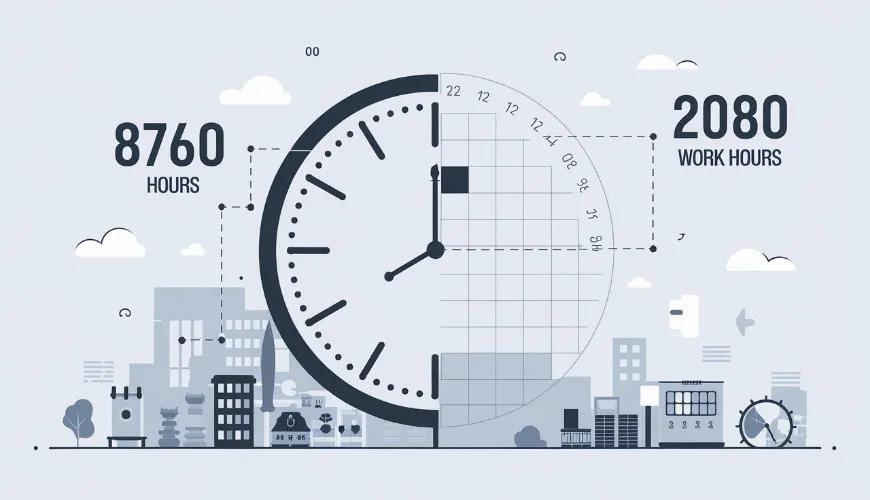

A standard year contains 8,760 hours.
A leap year contains 8,784 hours.
These numbers are used in payroll, salary conversion, work scheduling, education, budgeting, and time management. Many people search this topic because they need accurate yearly calculations for work or financial planning, not just a simple math answer.
The calculation is straightforward:
365×24=8,760
For leap years:
366×24=8,784
That extra 24 hours matters more than most people think. It affects hourly wage calculations, yearly forecasting, and even software systems that track time-based data.
Before looking at work hours and yearly conversions, it helps to understand why yearly hours are calculated differently in some years.
Standard Year vs Leap Year
A standard calendar year has 365 days.
Each day contains 24 hours.
That creates a total of:
- 8,760 hours
- 525,600 minutes
- 31,536,000 seconds
However, Earth does not orbit the sun in exactly 365 days. According to Wikipedia’s Leap Year page, the Earth takes approximately 365.2422 days to complete one orbit.
To keep calendars aligned with seasons, an extra day is added every four years. That creates a leap year with 366 days.
This is where many online calculators confuse users. Some always show 8,760 hours, even during leap years.
Image: Standard Year vs Leap Year Hour Comparison


How Many Hours Are in a Standard Year?
The exact formula is simple:
365×24=8,760
A standard year contains:
- 365 days
- 8,760 hours
- 525,600 minutes
- 31.5 million seconds
This calculation is widely used in:
- Salary conversions
- Utility estimates
- Subscription billing
- Project planning
- Productivity tracking
For example, many employers calculate hourly rates from yearly salaries using yearly work-hour estimates.
That leads directly to another important question people ask.
How Many Working Hours Are in a Year?
Most employees do not work all 8,760 hours in a year.
For a full-time schedule based on 40 hours per week:
40×52=2,080
A full-time employee typically works 2,080 hours per year before holidays and paid leave.
This number assumes:
- 40-hour workweeks
- 52 weeks annually
- No unpaid time off
Real working hours are usually lower.
After vacations, public holidays, and sick leave, actual annual work hours often range between:
- 1,750 and 1,950 hours
According to data from the Organisation for Economic Co-operation and Development (OECD), annual work hours vary significantly between countries.
For example:
- Germany averages lower yearly work hours
- Mexico records higher yearly averages
- The United States sits between those ranges
This matters for:
- Freelancers
- HR departments
- Payroll teams
- Contractors
- Business forecasting
Why Yearly Hour Calculations Matter
At first, yearly hours seem like a simple school-level calculation. In reality, they affect several real-world systems.
Salary Conversion
Many people divide annual salaries by yearly work hours to estimate hourly wages.
Example:
- $60,000 salary ÷ 2,080 hours
- Approximate hourly rate = $28.85
This method is common in:
- Job comparisons
- Freelance pricing
- Budget planning
Business Planning
Companies estimate yearly staffing needs using total work-hour calculations.
These estimates help with:
- Shift planning
- Production targets
- Overtime forecasting
Software & Technology
Servers and digital systems often track uptime in yearly hours.
Cloud platforms and hosting companies regularly use:
- 8,760-hour annual calculations
- Downtime percentage formulas
Even small time differences affect system performance metrics.
How Many Minutes Are in a Year?
The yearly minute calculation is:
8,760×60=525,600
A standard year contains 525,600 minutes.
This number appears often in:
- Productivity tools
- Scheduling software
- Educational materials
- Time-management systems
A leap year contains:
- 527,040 minutes
The difference again comes from the extra 24-hour day.
How Many Seconds Are in a Year?
Seconds are calculated by multiplying yearly minutes by 60.
525,600×60=31,536,000
A standard year contains:
- 31,536,000 seconds
A leap year contains:
- 31,622,400 seconds
These numbers are important in:
- Engineering
- Telecommunications
- Data science
- Astronomy
- Computing systems
Many software systems record timestamps down to milliseconds or seconds.
That is why accurate yearly calculations matter beyond simple math questions.
Image: Work Hours and Yearly Time Conversion Chart


Common Mistakes When Calculating Hours in a Year
Several calculation mistakes appear frequently online.
Ignoring Leap Years
Leap years add 24 extra hours.
Missing that detail creates inaccurate yearly estimates.
Confusing Total Hours With Work Hours
A year contains 8,760 total hours, but employees work far less.
Using the wrong figure causes salary conversion errors.
Assuming Every Month Has Equal Hours
Months vary between:
- 28 days
- 30 days
- 31 days
That changes monthly hour totals.
Forgetting Holidays and PTO
Real-world work schedules include:
- Paid leave
- National holidays
- Sick days
Ignoring them inflates annual work-hour estimates.
Quick Conversion Table
| Time Period | Hours |
|---|---|
| 1 Day | 24 |
| 1 Week | 168 |
| 1 Month (Average) | 730 |
| Standard Year | 8,760 |
| Leap Year | 8,784 |
| Full-Time Work Year | 2,080 |
This table helps users quickly compare different time calculations without using separate tools.
Final Answer
A standard year contains:
365×24=8,760
A leap year contains:
366×24=8,784
And a typical full-time employee works around:
40×52=2,080
These calculations are used daily in payroll, finance, scheduling, education, and business operations. Understanding the difference between total yearly hours and actual working hours helps avoid calculation mistakes and improves planning accuracy.
Frequently Asked Questions
Is every year exactly 8,760 hours?
No. Leap years contain 8,784 hours.
How many minutes are in a year?
A standard year contains 525,600 minutes.
How many seconds are in a year?
A standard year contains 31,536,000 seconds.
How many work hours are in a year?
A typical full-time employee works about 2,080 hours before leave deductions.
Why do leap years happen?
Leap years keep calendars aligned with Earth’s orbit around the sun.






[…] People Also Read : How Many Hours Are in a Year? Exact Calculations […]