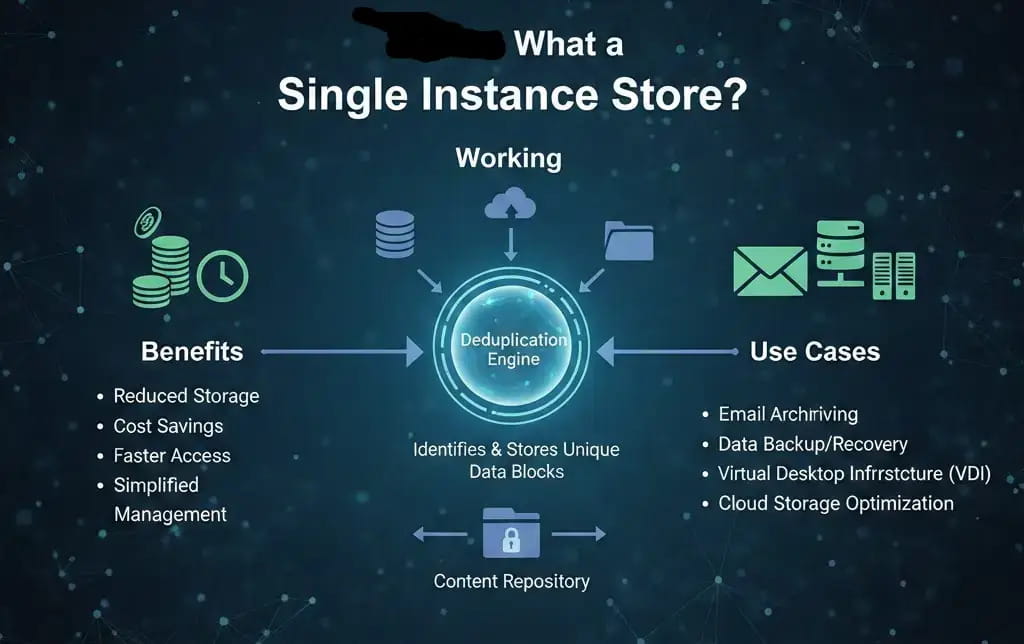

Modern storage systems generate massive amounts of duplicate data. The same email attachment, virtual machine image, backup file, or shared document may exist thousands of times across servers. A Single Instance Store (SIS) solves this problem by storing only one physical copy of identical data and replacing duplicates with references.
In enterprise environments, duplicate data can consume 30% to 60% of total storage capacity, especially in email servers, backup systems, and virtual desktop infrastructure. SIS reduces this waste without changing how users access files.
This is why storage vendors, cloud platforms, and backup providers still use SIS principles inside modern deduplication systems. Even though the term is older, the underlying technology remains highly relevant for controlling storage costs and improving backup efficiency.
Before discussing advanced storage optimization, it is important to understand how SIS actually works behind the scenes.
What Is a Single Instance Store?

A Single Instance Store is a storage method where identical files or data blocks are stored only once on physical storage.
Instead of saving multiple copies of the same file, the system creates:
- One real stored copy
- Multiple references or pointers to that copy
For users, nothing changes. Every user still sees and accesses the file normally.
For example:
- 5,000 employees receive the same PDF attachment
- Without SIS, the attachment may be stored 5,000 times
- With SIS, only one copy exists physically
The remaining copies become lightweight references.
This concept is closely related to [Data deduplication], although both technologies operate differently in many environments.
How Single Instance Store Works
File Identification and Hashing
SIS systems first identify duplicate content using cryptographic hash values.
Common hashing algorithms include:
- MD5
- SHA-1
- SHA-256
When two files generate the same hash, the system treats them as identical.
This allows storage systems to compare files quickly without reading every byte repeatedly.
Reference-Based Storage
After detecting duplicates:
- One file becomes the master copy
- Duplicate versions become metadata references
Users still access files normally because the operating system resolves the references automatically.
This is why SIS can reduce storage usage without affecting the user experience.
Metadata Management
SIS depends heavily on metadata tables.
These tables track:
- File locations
- Reference counts
- Ownership mappings
- Access permissions
Efficient metadata handling is critical in large enterprise deployments where millions of references may exist.
Automatic Cleanup
When users delete files, SIS checks whether other references still exist.
If references remain:
- The master file stays intact
If all references disappear:
- The storage system removes the physical copy automatically
This process prevents orphaned data from consuming storage space.
Single Instance Store vs Data Deduplication
Many people use SIS and deduplication interchangeably, but they are not identical technologies.
| Feature | Single Instance Store | Data Deduplication |
|---|---|---|
| Optimization Level | File-level | Block-level or byte-level |
| Storage Efficiency | Moderate | Higher |
| Complexity | Lower | Higher |
| Processing Overhead | Lower CPU usage | Higher CPU usage |
| Common Use Case | Email systems | Backup appliances |
SIS works best when entire files are duplicated repeatedly.
Deduplication performs better when only portions of files are duplicated.
Modern enterprise systems often combine both approaches.
Main Benefits of Single Instance Store
Reduced Storage Consumption
Storage reduction is the biggest advantage.
In email environments, SIS historically reduced attachment storage by up to 70%.
Large organizations handling repetitive documents can save terabytes of storage capacity annually.
Faster Backup Operations
Smaller storage footprints reduce:
- Backup windows
- Replication traffic
- Network bandwidth usage
This improves recovery planning and disaster recovery operations.
Lower Infrastructure Costs
Reduced storage demand directly lowers:
- Hardware purchases
- SSD expansion costs
- Cloud storage bills
- Backup infrastructure expenses
For enterprises managing petabytes of data, these savings become significant.
Improved Data Consistency
Because only one master copy exists, organizations avoid situations where duplicate versions become outdated or inconsistent.
This is particularly useful in centralized document systems.
Common Use Cases of Single Instance Store
Email Servers
One of the earliest SIS implementations appeared in Microsoft Exchange Server environments.
Large email systems stored identical attachments only once, even when sent to thousands of users.
This dramatically reduced mailbox database growth.
Backup and Archiving Platforms
Backup vendors use SIS principles to eliminate redundant backup copies.
This is especially effective in:
- Daily incremental backups
- Long-term retention archives
- Disaster recovery replicas
Virtual Desktop Infrastructure (VDI)
VDI deployments often contain thousands of identical operating system files.
SIS minimizes duplication across virtual machines, improving storage efficiency in enterprise virtualization.
Cloud Storage Systems
Cloud providers apply SIS-like techniques internally to optimize object storage systems and reduce infrastructure costs.
While implementation details vary, the principle remains similar:
- Store identical content once
- Reference it many times
Technical Challenges of Single Instance Store
Although SIS improves storage efficiency, it also introduces technical complexity.
Hashing Overhead
Every incoming file must be hashed and compared.
In large-scale environments, this increases:
- CPU utilization
- Index lookup operations
- Metadata processing requirements
Metadata Scalability
The larger the storage environment becomes, the larger the reference database grows.
Poor metadata management can create:
- Latency
- Slow retrieval performance
- Increased failure risks
File Modification Issues
If users modify shared files, the system must:
- Create new versions
- Break shared references
- Update metadata structures
This process adds operational overhead.
Recovery Complexity
Backup restoration becomes more complicated because restoring a single file may require rebuilding reference chains correctly.
Enterprise backup software handles this automatically, but architecture complexity still increases.
Security and Compliance Considerations
SIS systems must maintain strong data integrity controls.
If metadata becomes corrupted, multiple file references may fail simultaneously.
Organizations handling regulated data also need to verify:
- Compliance retention policies
- Encryption compatibility
- Audit logging requirements
Encrypted files present another limitation.
Even identical encrypted files may appear unique because encryption changes the file signature.
This reduces SIS efficiency significantly.
Real-World Examples of Single Instance Store
Windows SIS Technology
Microsoft introduced SIS capabilities in older Windows server environments using NTFS-based storage optimization.
The technology primarily targeted:
- Remote installation services
- Shared file environments
- Enterprise deployment systems
Enterprise Backup Appliances
Modern backup vendors still use SIS concepts internally.
Storage appliances from enterprise providers combine:
- Compression
- Deduplication
- Single-instance optimization
This improves backup retention efficiency substantially.
SaaS Platforms
Many SaaS providers use shared object storage architectures where duplicate customer content may be internally optimized using SIS-style logic.
Best Practices for Implementing SIS
Organizations planning SIS deployment should evaluate duplicate data ratios first.
The highest efficiency usually appears in:
- Email systems
- Backup repositories
- Virtual machine environments
- Shared enterprise documents
Additional recommendations include:
- Monitor metadata database performance
- Use reliable hashing algorithms
- Combine SIS with compression technologies
- Maintain strong disaster recovery procedures
- Test restore operations regularly
Without proper monitoring, metadata bottlenecks can offset storage benefits.
Limitations of Single Instance Store
SIS is not ideal for every workload.
Its efficiency drops in environments containing:
- Highly unique datasets
- Encrypted content
- Compressed media files
- Frequently changing files
Modern block-level deduplication systems often outperform traditional SIS in large-scale storage infrastructures.
Still, SIS remains valuable because it offers lower complexity and faster implementation in many use cases.
Future of Single Instance Store Technology
Modern storage systems continue evolving toward intelligent data optimization.
Today, SIS concepts appear inside:
- Cloud-native storage systems
- Hybrid cloud architectures
- AI-driven storage management platforms
- Enterprise backup software
As enterprise data volumes continue growing, duplicate data elimination remains critical for controlling infrastructure costs.
Research from industry analysts consistently shows global enterprise data growth exceeding 20% annually. Storage optimization technologies like SIS continue playing a role in managing this expansion efficiently.
Frequently Asked Questions
What is a Single Instance Store?
A Single Instance Store is a storage method that keeps only one physical copy of identical data while using references for duplicates.
Is SIS the same as deduplication?
No. SIS usually works at the file level, while deduplication often works at block or byte level.
Where is SIS commonly used?
SIS is commonly used in:
- Email servers
- Backup systems
- Cloud storage
- Virtual desktop infrastructure
Does SIS improve backup performance?
Yes. Reduced storage size lowers backup duration and bandwidth requirements.
Conclusion
Single Instance Store remains an important storage optimization concept despite the rise of modern deduplication systems.
Its ability to eliminate duplicate files helps organizations reduce storage consumption, improve backup efficiency, and lower infrastructure costs.
Although newer storage architectures now use more advanced deduplication methods, SIS principles still appear across enterprise backup platforms, cloud storage systems, and virtualization environments.
For businesses managing repetitive data at scale, understanding how SIS works is still highly relevant in modern storage planning.
Visual Overview of Single Instance Store

Common Enterprise Environments Using SIS