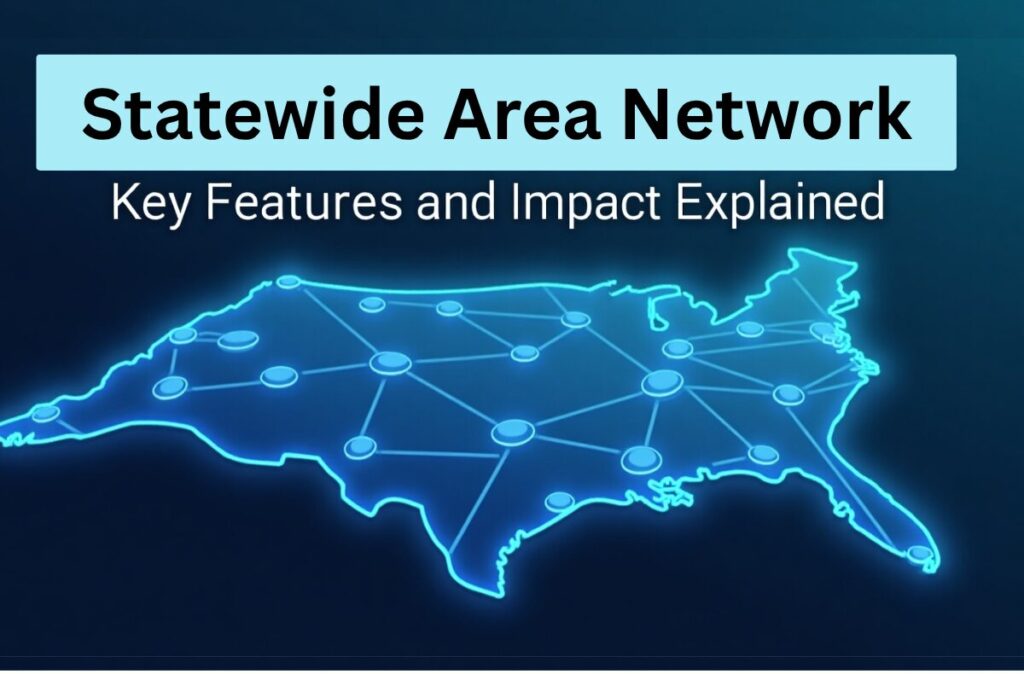

A State Wide Area Network (SWAN) is a government-operated or managed high-speed telecommunications backbone that securely connects state agencies, local governments, schools, courts, public safety offices, and other public facilities across an entire state. It replaces fragmented, agency-specific networks with a unified, scalable infrastructure to improve efficiency, security, and service delivery while supporting broadband expansion goals.
This guide covers the policy rationale, technical options, deployment considerations, security requirements, and best practices for modern SWAN implementations.
1. The Benefits: Policy and Economic Advantages
Economies of Scale and Cost Reduction Independent agency networks lead to duplicated contracts, hardware, staffing, and operations. A centralized SWAN consolidates procurement and management, often delivering 20–40% reductions in wide-area networking costs within the first contract term. Savings can be redirected to public priorities such as education, healthcare, and digital modernization.
Real-Time Inter-Agency Collaboration A unified low-latency backbone enables seamless data sharing for public health outbreaks, emergency response, law enforcement coordination, court systems, and eligibility verification. Predictable performance (e.g., sub-20ms latency) replaces unreliable VPNs and inconsistent commercial links.
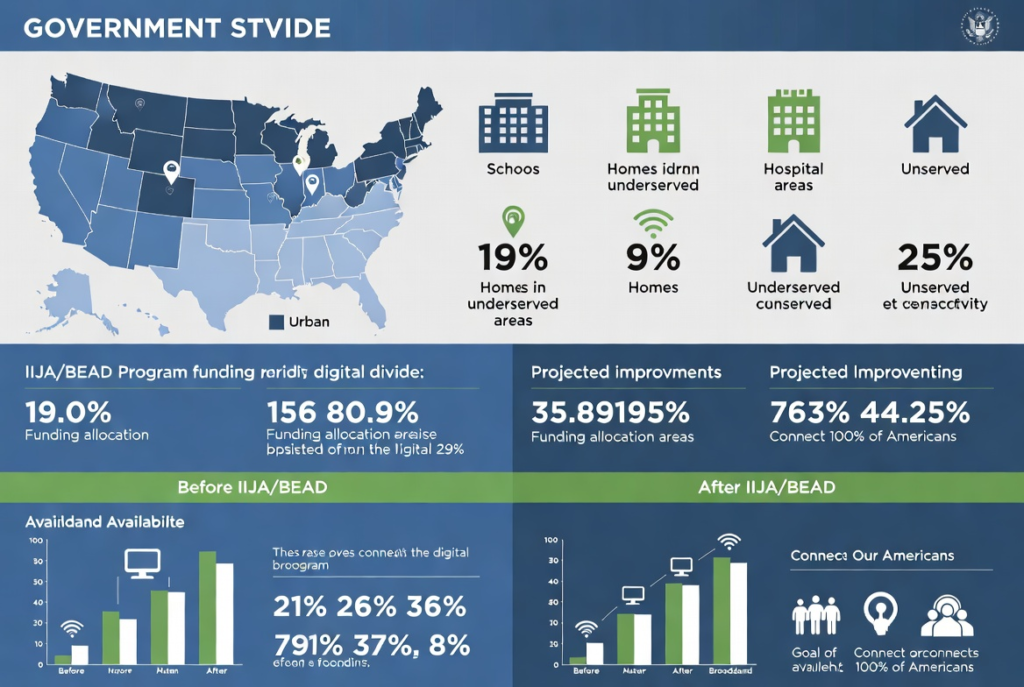
Addressing the Digital Divide and IIJA/BEAD Compliance The Infrastructure Investment and Jobs Act (IIJA) and Broadband Equity, Access, and Deployment (BEAD) program emphasize state-led solutions for unserved and underserved areas. SWANs leverage government rights-of-way to extend connectivity to rural communities, supporting telehealth, remote education, and online government services.
Public Safety and Reliability SWAN contracts typically enforce strict SLAs: 99.99% uptime and low-latency guarantees critical for 911, dispatch, and first-responder systems. Dedicated capacity and in-house Network Operations Centers (NOCs) enable faster failover than commercial internet.
2. Types of SWAN Architectures
The architecture choice affects cost, resilience, scalability, and long-term flexibility. Here are the primary models:
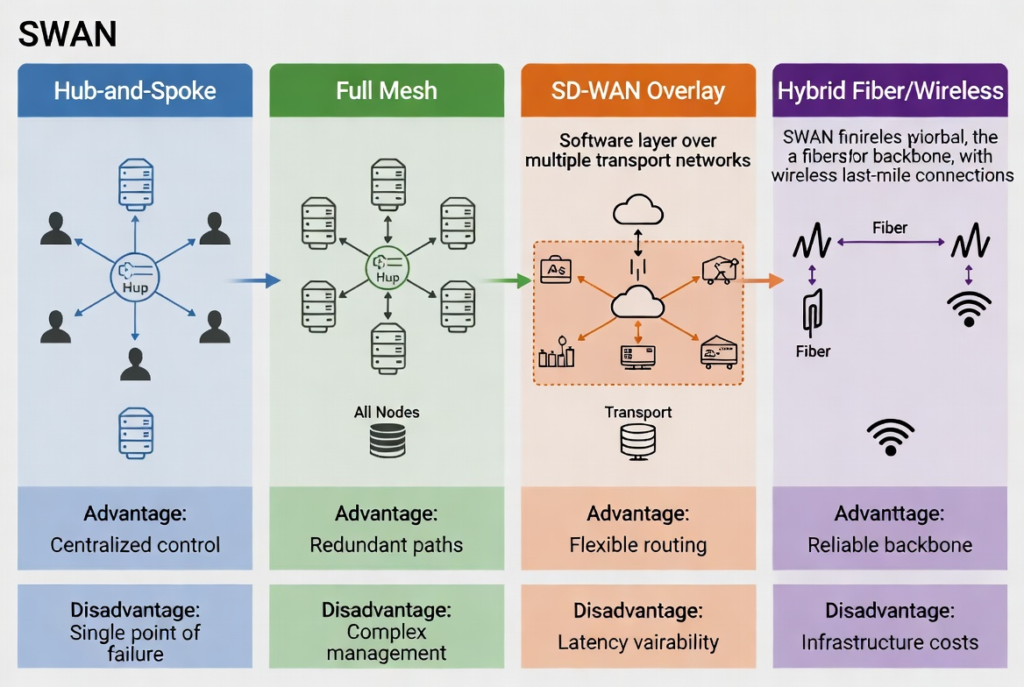
| Architecture | Cost | Scalability | Redundancy | Best For |
|---|---|---|---|---|
| Hub-and-Spoke | Low | Limited | Poor | Simple initial deployments |
| Mesh Topology | High | Excellent | Excellent | High-priority critical sites |
| SD-WAN Overlay | Moderate | Excellent | Strong | Modern, cloud-integrated networks |
| Hybrid Fiber/Wireless | Moderate | Good | Moderate | Large rural states |
Recommended Gold Standard (2025+): SD-WAN Overlay on a Fiber Backbone This approach combines intelligent, policy-driven routing with dedicated transport. It supports application-aware prioritization (e.g., routing public safety traffic over the best path), zero-trust security, cloud on-ramps, and multi-path redundancy. It is particularly effective for states modernizing legacy MPLS networks.
3. Deployment and Capacity Planning
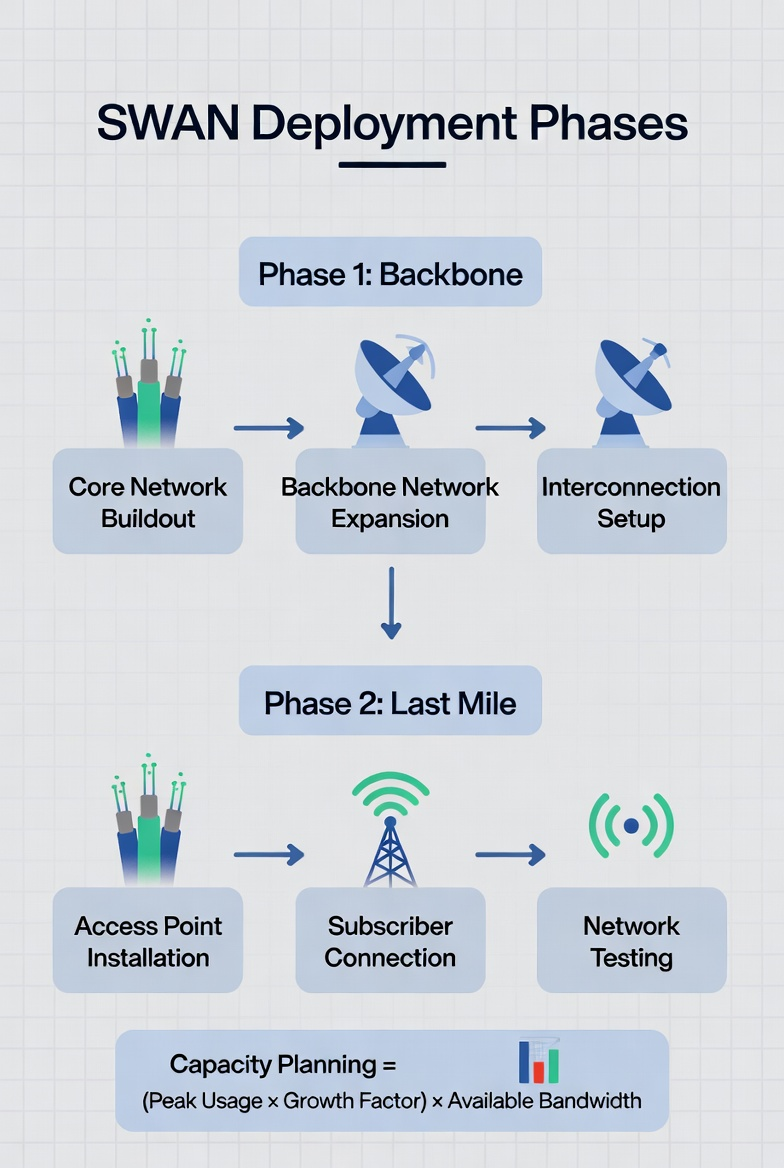
Capacity Baseline Start with 1 Gbps aggregated capacity per 500 concurrent users at access layers. Scale core links in 10 Gbps or 100 Gbps increments based on workloads (e.g., GIS, video, cloud services).
Geographic Considerations
- Large/rural states (e.g., Texas, Montana): Focus on phased fiber backbone builds between major areas, then hybrid wireless/satellite for last mile. Inventory existing public fiber assets first (DOT conduits, universities, cooperatives).
- Dense states (e.g., New Jersey, Maryland): Emphasize contract consolidation and governance alignment.
Points of Presence (PoPs) Deploy 8–12 regional PoPs for a typical state to aggregate traffic locally, reducing latency and improving resilience. Choose locations near agency clusters, carrier-neutral facilities, and Internet Exchange Points.
Last-Mile Options (Priority Order)
- Dark fiber extensions
- Licensed microwave
- CBRS/fixed wireless
- LEO satellite (as backup)
4. Security, Compliance, and Maintenance
Federal compliance is mandatory for any SWAN carrying sensitive data:
- CJIS — For law enforcement (encryption, segmentation, personnel screening)
- HIPAA — For health data (safeguards for ePHI)
- FedRAMP — For cloud connections
Key Security Practices
- Strict network segmentation with VLANs and next-generation firewalls
- Zero-trust principles (authenticate every connection)
- Network Access Control (NAC) at edges
- 30/60/90-day patch management cycles
- 24/7 NOC with defined SLAs
Regular audits prevent configuration drift and lateral movement risks.
5. Recommended Technologies
- Managed SD-WAN — For intelligent routing, security overlays, and cloud integration
- Dark Fiber / Fiber-as-a-Service (FaaS) — For long-term cost control and capacity ownership
These technologies align with government requirements for reliability and compliance.
Real-World Examples
States like California (CGEN), Texas (DIR Network), and Virginia (VITA) have implemented successful SWANs, demonstrating cost savings, improved services, and better rural connectivity.
Conclusion and Next Steps
A well-designed SWAN delivers operational efficiency, stronger public safety, and progress toward digital equity. Success depends on thorough planning, stakeholder alignment, and vendor partnerships that prioritize compliance and future-proofing.