



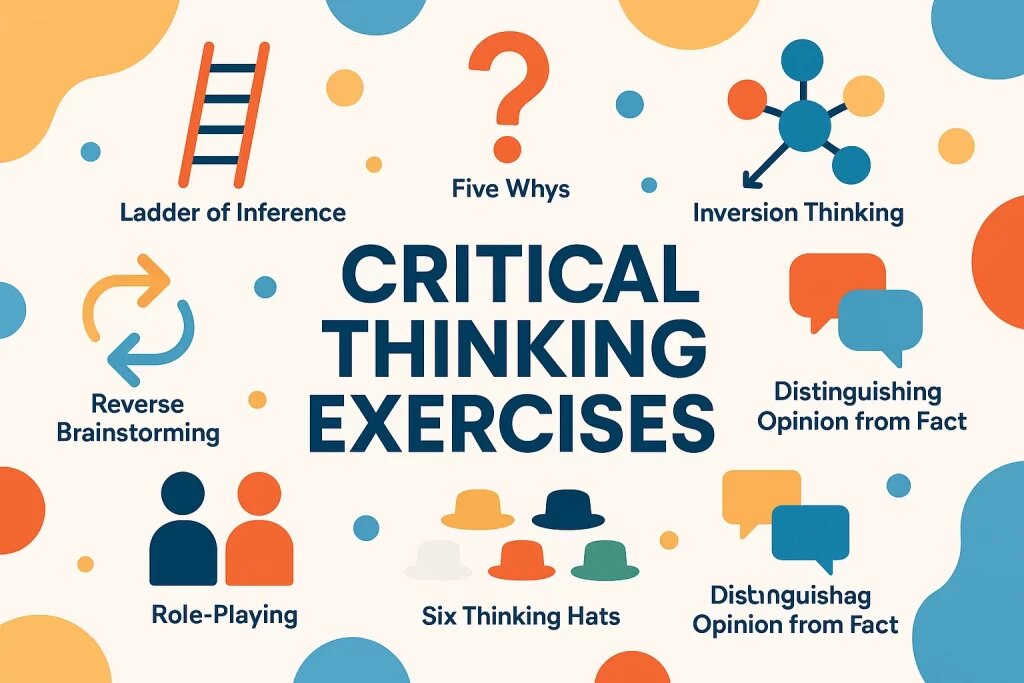

Most people don’t struggle with understanding critical thinking. They struggle with applying it in real situations. This guide focuses on exercises that directly improve decision-making, problem-solving, and analysis—without wasting time on theory.
Here’s what matters upfront: effective critical thinking exercises must force you to question assumptions, evaluate evidence, and make decisions under constraints. If an activity doesn’t do all three, it won’t build real skill.
You’ll find below a set of structured exercises used in business analysis, marketing strategy, and everyday decision-making. Each one is practical, measurable, and repeatable.
Now let’s break down what actually makes these exercises work.
What Makes a Critical Thinking Exercise Effective
Most online lists fail because they focus on passive learning. Reading or watching content does not build thinking ability.
An effective exercise must include:
- A clear problem to solve
- Limited or conflicting information
- A forced decision
- A reflection step
Research from the World Economic Forum ranks critical thinking among the top core skills for modern jobs. Yet, most professionals never train it deliberately.
This gap is exactly where structured exercises create results.
1. Assumption Breakdown Drill
Every decision is built on assumptions. Most go unnoticed.
How to do it:
- Write one belief (e.g., “This marketing channel doesn’t work”)
- List all assumptions behind it
- Challenge each assumption with data or counterexamples
Why it works:
It exposes hidden biases that affect judgment.
Use case:
In SEO campaigns, many assume “high traffic keywords = conversions.” Breaking this assumption often reveals intent mismatch.
2. The 5 Whys Technique (Root Cause Analysis)
Surface-level thinking leads to repeated mistakes.
Process:
- Take one problem
- Ask “Why?” five times
Example:
- Campaign failed → Why? Low clicks
- Why? Weak headline
- Why? Misaligned with user intent
- Why? Poor keyword research
- Why? No SERP analysis
Now you’re solving the real issue.
This method is widely used in lean systems and explained in detail on Wikipedia under root cause analysis concepts.
3. Perspective Switching Exercise
Most decisions fail due to one-sided thinking.
How it works:
- Take your opinion
- Argue the exact opposite
Example:
If you think “Paid ads are better than SEO,” argue why SEO is superior.
Result:
You uncover blind spots and strengthen your reasoning.
4. Evidence vs Opinion Sorting
In a world of content overload, this is a critical skill.
Exercise:
- Take any article or report
- Highlight:
- Facts (data, statistics)
- Opinions (interpretations)
A study by Stanford University found that over 80% of students struggle to distinguish between sponsored content and real news.
This exercise directly improves research quality and decision-making.
5. Constraint-Based Problem Solving
Unlimited thinking creates unrealistic solutions.
Method:
- Solve a problem with strict limits
- Budget: $100
- Time: 24 hours
- Tools: free only
Example:
“How would you generate leads without ads?”
This forces creativity and prioritization—two core thinking skills.
6. Decision Matrix Exercise
When multiple options exist, intuition is not enough.
Steps:
- List options
- Define criteria (cost, impact, time)
- Assign weights
- Score each option
This reduces emotional bias and improves clarity.
Businesses using structured decision-making frameworks report up to 20% faster decision cycles (McKinsey data).
7. Cognitive Bias Identification Drill
Bias is the biggest enemy of clear thinking.
Exercise:
- Review a past decision
- Identify biases:
- Confirmation bias
- Anchoring bias
- Availability bias
Understanding these patterns improves future decisions.
For deeper reading, explore Thinking, Fast and Slow which explains how biases affect thinking systems.
Daily 10-Minute Critical Thinking Routine
Consistency matters more than intensity.
Simple structure:
- 3 minutes: Question one assumption
- 3 minutes: Analyze one decision
- 4 minutes: Reflect on outcome
This builds a feedback loop, which most people skip.
After a few weeks, you’ll notice faster and clearer thinking.
Critical Thinking Exercises by Skill Level
Beginner:
- Fact vs opinion sorting
- 5 Whys
Intermediate:
- Assumption breakdown
- Perspective switching
Advanced:
- Decision matrix
- Bias analysis
Progression matters. Jumping to advanced methods too early reduces effectiveness.
Applying These Exercises in Real Life
This is where most guides fall short. Exercises must connect to real scenarios.
Work / Business:
- Analyze why campaigns fail
- Evaluate client strategies
- Identify content gaps
Personal Decisions:
- Financial planning
- Evaluating advice
Common Mistakes That Block Progress
- Practicing without reflection
- Relying only on intuition
- Avoiding uncomfortable questions
- Inconsistent practice
Critical thinking is not a one-time skill. It’s a repeatable process.
Measurable Benefits of These Exercises
When applied consistently, these exercises lead to:
- Faster decision-making
- Better problem accuracy
- Improved communication
- Stronger analytical skills
A report by the World Economic Forum highlights that analytical thinking remains the #1 skill across industries.
Visual Guide: Critical Thinking Flow
Final Takeaway
Critical thinking improves only through structured practice.
Start with one exercise. Apply it to a real problem. Reflect on the outcome.
Then repeat.
That’s how better decisions are built.





[…] Critical Thinking Exercises That Improve Real Decision-Making […]
[…] MP4 is the most compatible video format. It works on Windows, Android, iPhone, smart TVs, and editing software. That’s why nearly all converters default to MP4 instead of formats like AVI or MKV. […]