



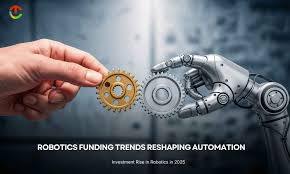

Robotics funding is moving, and the data shows where real traction exists. Recent rounds are not evenly distributed. Capital is concentrating in three areas: industrial automation, robot intelligence software, and service robotics. Multi-million and even billion-dollar rounds are going to companies with proven deployments, not early prototypes.
In the last funding cycle, several companies raised between $50M and $450M. These rounds are tied to production readiness, not concepts. Investors are prioritizing revenue visibility, repeatable use cases, and deployment scale. That shift explains why warehouse robotics, logistics automation, and embodied AI platforms dominate funding headlines.
This article tracks those deals, explains where the money is going, and shows what each funding round actually signals. Instead of repeating press releases, the focus here is on what matters: numbers, trends, and decisions behind the capital.
Now, let’s look at the latest funding rounds and what they reveal.
Latest Robotics Funding Rounds

Recent funding rounds show a clear pattern: companies with working systems and enterprise customers are raising the most.
- Pudu Robotics — ~$150M raised
Focus: service robots for hospitality and retail
Insight: strong demand in labor-constrained industries - RoboForce — ~$52M raised
Focus: industrial robotics deployment
Insight: mid-stage companies with real deployments are attracting capital - Rhoda AI — ~$450M Series A
Focus: robot intelligence platforms
Insight: software layers for robotics are becoming a major investment category
These deals are not isolated. Across funding databases, robotics startups raised billions collectively over the past 12–18 months. The majority of that capital is going into scaling production and improving AI-driven autonomy.
And that leads to the next question: where exactly is this money going?
Biggest Funding Themes by Robotics Segment
The funding is not spread evenly. It is highly concentrated in specific segments that solve immediate business problems.
Commercial Service Robots
Restaurants, hotels, and retail chains are deploying robots to reduce labor costs.
Funding here is tied to proven ROI, often within 12–18 months.
Humanoid and General-Purpose Robots
Still early, but attracting large rounds.
Investors are betting on long-term scalability rather than short-term revenue.
Industrial and Warehouse Automation
This is the most mature segment.
Companies with logistics automation solutions are seeing consistent funding due to clear efficiency gains.
Inspection, Logistics, and Defense Robotics
Funding is driven by operational necessity.
Use cases include infrastructure inspection, surveillance, and supply chain automation.
Robot-Intelligence Software
This is the fastest-growing category.
Instead of building hardware, companies are building AI systems that control robots.
This includes perception models, navigation systems, and multi-robot coordination platforms.
Each of these segments solves a different problem. But the common factor is measurable output.
So why are investors moving aggressively into robotics now?
Why Investors Are Backing Robotics Now
The shift is not random. It is driven by measurable economic pressure.
Labor shortages are increasing across logistics, manufacturing, and service sectors. Robotics offers a direct replacement or augmentation. This creates immediate demand.
Deployment costs are decreasing. Hardware is becoming more standardized. Software is improving faster due to advances in machine learning and data collection.
Return on investment is now easier to calculate. Many robotics solutions show cost recovery within 1–3 years. That makes them easier to justify for enterprise buyers.
At the same time, AI advancements are accelerating robotics capabilities. Technologies explained in <a href=”https://en.wikipedia.org/wiki/Robotics”>robotics</a> are now combining with large-scale machine learning systems, enabling more adaptable and intelligent machines.
This combination of economic pressure and technical readiness is driving funding decisions.
But funding alone does not tell the full story. The structure of each deal matters.
What Each Funding Round Tells You
Not all funding rounds mean the same thing. You need to read the signals behind the numbers.
- Round size shows ambition, not success
- Valuation reflects expectations, not performance
- Stage indicates risk level
- Lead investors signal confidence from experienced capital
- Use of funds reveals the company’s real bottleneck
For example, if funding is allocated to manufacturing, the company likely already has product-market fit. If it is going into R&D, the product is still evolving.
Another key signal is customer concentration. Companies with repeat enterprise clients are more likely to scale successfully.
Understanding these signals helps filter meaningful funding news from noise.
And that leads to the practical side: what does this mean for different stakeholders?
What This Means for Founders, Buyers, and Investors
For Robotics Founders
Funding is available, but expectations are higher.
Investors want proof of deployment, not just prototypes.
Revenue and customer traction matter more than technical novelty.
For Enterprise Buyers
More options are entering the market.
But not all solutions are mature.
Focus on systems with proven uptime, support, and integration capability.
For Investors
The robotics market is becoming segmented.
Industrial automation is lower risk.
Humanoid robotics carries higher risk but potentially higher returns.
Each group needs to evaluate robotics funding differently. The same deal can signal opportunity or risk depending on perspective.
However, there are still clear risks that should not be ignored.
Risks and Red Flags to Watch
Not every funded company will succeed. Several risks remain consistent across the sector.
Manufacturing complexity is a major barrier. Scaling hardware is difficult and expensive.
Safety and compliance can delay deployment. This is especially critical in industrial environments.
Sales cycles are long. Enterprise customers take time to adopt new systems.
Unit economics are not always clear. Some solutions look promising but fail to deliver cost savings at scale.
These risks explain why investors are selective, even in a growing market.
So how can you track all this efficiently?

Robotics Funding Tracker by Month or Quarter
A structured tracking approach makes this easier.
Track funding rounds by:
- Date
- Segment
- Amount raised
- Deployment stage
This helps identify patterns over time. For example, a surge in warehouse robotics funding may indicate growing demand in logistics.
Regular tracking also reveals which segments are slowing down. That information is often more valuable than headline funding news.
FAQ
Which robotics segments are raising the most money?
Industrial automation and robot-intelligence software currently lead funding. These segments show clear ROI and scalability.
Are humanoid robots getting the biggest rounds?
Some large rounds exist, but they are still high-risk. Most capital is still flowing into practical, deployable systems.
What do investors look for before funding a robotics startup?
Deployment history, revenue potential, scalability, and strong technical teams.
How do robotics funding rounds affect the market?
They accelerate development, increase competition, and push adoption across industries.
Final Takeaway
Robotics funding news is no longer about experimental technology. It is about deployment, efficiency, and measurable outcomes.
The companies raising capital today are solving real problems. They are reducing labor costs, improving productivity, and scaling automation.
For readers tracking this space, the key is simple: focus on where the money is going and why. That is where the real story is.





[…] Robotics adoption is growing fastest in repetitive construction tasks. […]
[…] of purchasing dozens of disconnected HR tools, many companies now prefer unified platforms with automation built […]
[…] Smart mapping software […]