



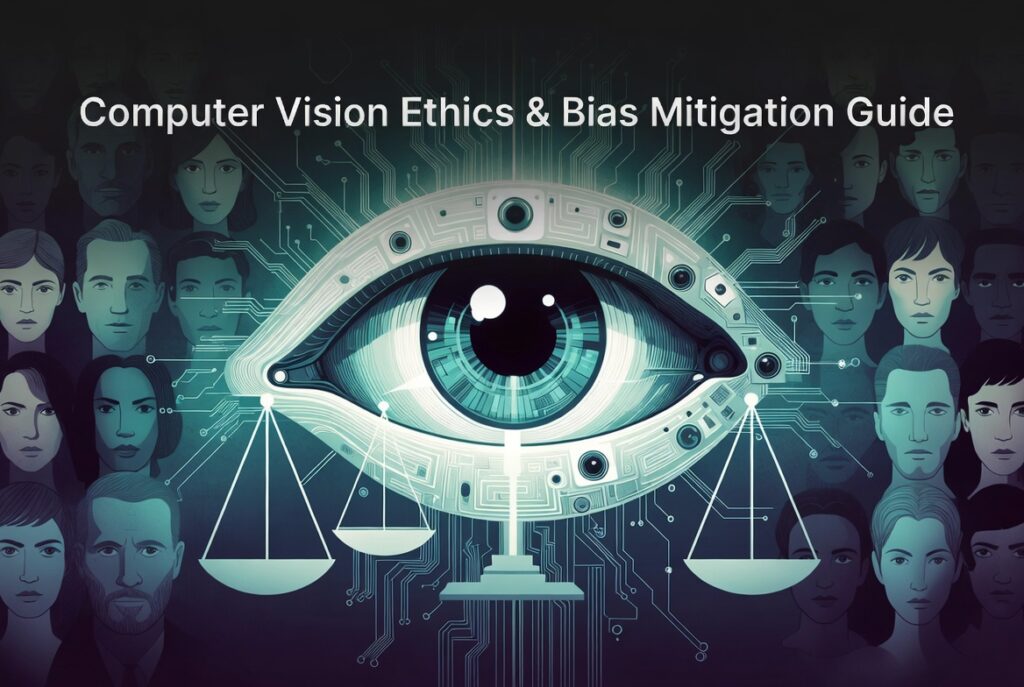

Computer vision systems show real performance gaps across demographics. A 2018 MIT study found error rates of 0.8% for light-skinned men in gender classification, but up to 34.7% for darker-skinned women.
These gaps appear in facial recognition, object detection, medical imaging, and autonomous vehicles. Wrongful arrests have occurred due to misidentifications, mostly affecting people of color. Datasets like ImageNet and Caltech101 contain imbalances — cars mostly from side views or racing types, faces skewed toward lighter skin.
This guide delivers practical steps to detect, measure, and reduce bias in computer vision pipelines. It covers data audits, mitigation techniques, ethical frameworks, and deployment workflows. You will find tools, metrics, and checklists you can apply today.
Discover More : Model Architecture Best Practices for CV Deployments in 2026
Why Bias Appears in Computer Vision
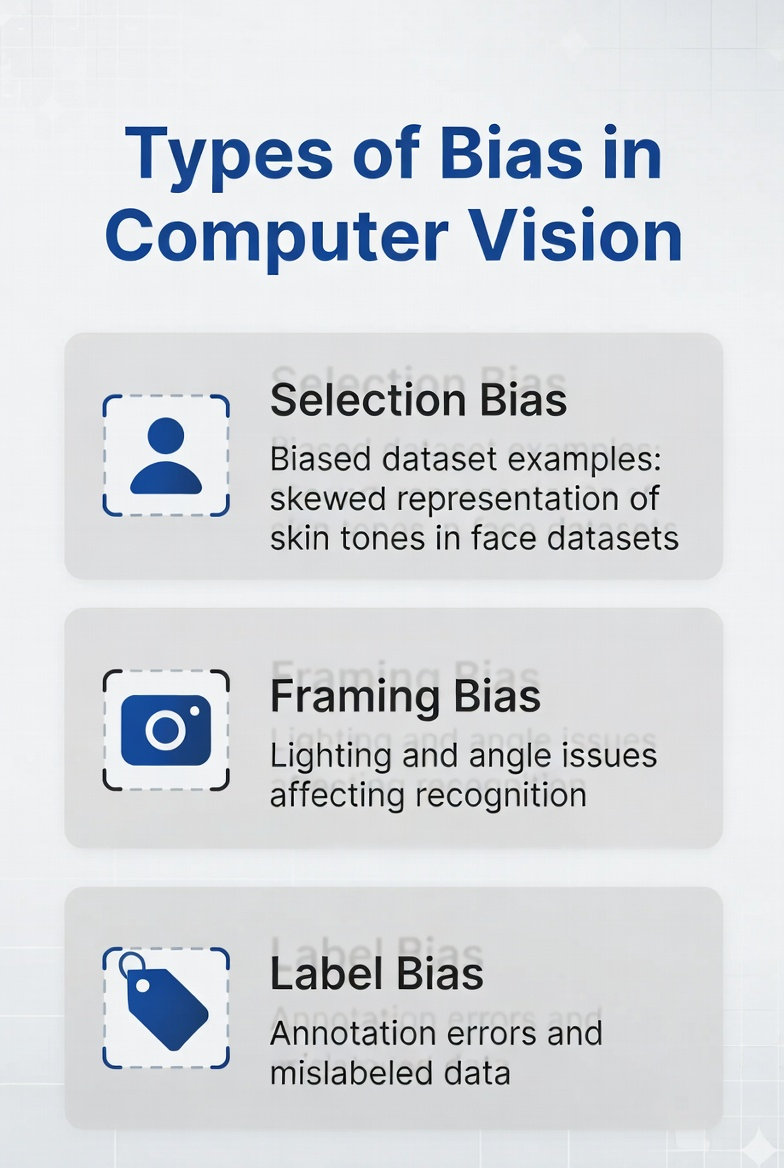
Bias enters at multiple stages. Selection bias happens when datasets underrepresent groups. Framing bias comes from lighting, angles, or cropping that favors certain appearances. Label bias arises during annotation with subjective or incomplete categories.
Algorithmic bias amplifies these issues during training. Models learn spurious correlations, such as associating specific backgrounds with objects or skin tones with outcomes.
Real impacts include healthcare imaging that performs worse on certain skin tones and surveillance systems with higher false positives for women and minorities. NIST reports confirm higher false positive rates for African American and Asian faces compared to Caucasian ones in many systems.
Detecting Bias: Start With Your Data
Begin audits early. Use statistical tools to check distributions across skin tone, gender, age, and geography.
REVISE (REvealing VIsual biaSEs) helps flag object, gender, and geography biases in datasets.
Calculate fairness metrics: Demographic Parity, Equal Opportunity, and Equalized Odds. Break down model accuracy by subgroups using confusion matrices.
Visualize with Grad-CAM or LIME to see which features the model relies on. If it focuses on skin color instead of facial structure for identity, bias is present.
Test on balanced benchmarks. Compare performance on CelebA, RFW (Racial Faces in the Wild), or your own diverse test sets.
Mitigation Strategies That Work
Apply fixes at three stages.
Pre-processing: Balance datasets through targeted collection or augmentation. Generate synthetic faces with GANs to fill gaps. Re-weight samples so underrepresented groups influence training more.
In-processing: Add fairness constraints during training. Use adversarial debiasing to remove protected attribute information. Apply regularization that penalizes performance differences across groups.
Post-processing: Adjust decision thresholds per subgroup. Calibrate outputs to reduce disparate impact.
Recent methods like Centroid Fairness Loss or Targeted Augmentations for Bias Mitigation (TAB) show promise without heavy hyperparameter tuning.
Compare techniques in practice. Pre-processing often preserves accuracy better but requires good data. In-processing gives strong control but increases training time.
Ethical Frameworks for Responsible Development
Ethics go beyond technical fixes. Follow principles of fairness, privacy, transparency, and accountability.
The Ethics of artificial intelligence page on Wikipedia discusses algorithmic bias and fairness in detail.
Integrate ethics-by-design. Conduct impact assessments before projects start. Document data sources and model decisions.
Privacy matters. Use federated learning or homomorphic encryption for sensitive visual data. Avoid unnecessary collection of biometric information.
Regulatory Landscape
The EU AI Act classifies many computer vision systems as high-risk, especially in biometric identification and law enforcement. These require rigorous testing, documentation, and human oversight.
NIST provides standards for bias measurement. Follow them to build compliant systems.
Organizations should create internal governance with ethics boards and regular audits.
Step-by-Step Implementation Workflow
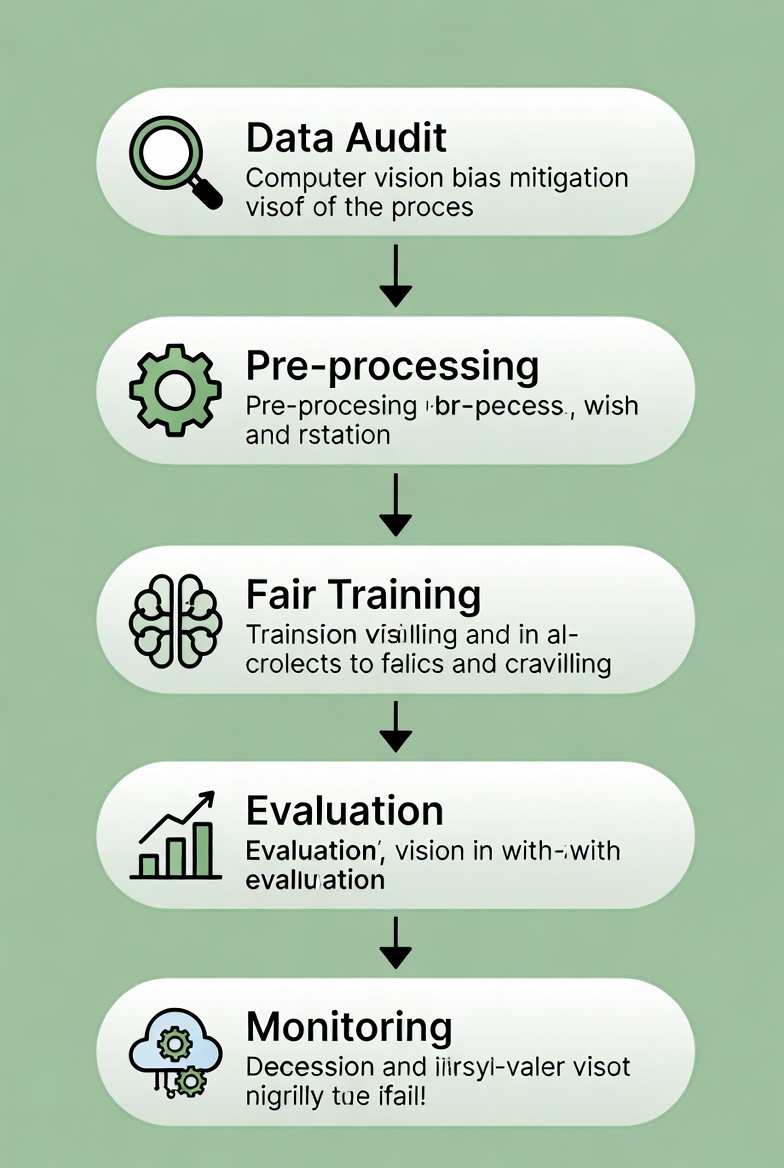
- Define the problem and identify protected attributes.
- Audit existing data and models for disparities.
- Improve data with balancing techniques.
- Train with fairness constraints.
- Evaluate across subgroups and edge cases.
- Monitor in production and retrain as needed.
Track metrics over time. Watch for performance drops on new demographics or environments.
Common pitfalls include ignoring intersectionality (e.g., dark-skinned older women) or optimizing only for aggregate accuracy.
Industry Examples
In healthcare, skin cancer detection models have shown accuracy gaps across skin tones. Mitigation through diverse training data improved outcomes.
Autonomous vehicles struggle with pedestrians in varied lighting or clothing. Diverse scene datasets and adversarial testing help close these gaps.
Law enforcement cases highlight risks. Multiple wrongful arrests linked to biased facial recognition led to moratoriums in some cities.
Success comes from teams that combine technical audits with stakeholder input from affected communities.
Building Trustworthy Systems
Start small. Audit one model this week using open tools like Fairlearn adapted for vision or IBM AI Fairness 360.
Create a bias mitigation playbook for your team. Share results openly where possible to advance the field.
Computer vision offers powerful capabilities. Responsible development ensures these benefits reach everyone fairly.
This guide provides concrete actions. Apply the audits, use the metrics, and implement stage-wise mitigation. Your systems will perform better and create fewer unintended harms.
Resources
- Fairness toolkits (AI Fairness 360, Fairlearn)
- Diverse datasets for testing
- EU AI Act summaries for compliance
- Regular literature reviews on arXiv for new techniques
Keep learning. The field moves fast, but core principles of measurement, mitigation, and monitoring stay consistent.





[…] – 25May2026 AI Technology The Science of Machine Visual Perception: How AI Sees the World AI Technology Computer Vision Ethics & Bias Mitigation Guide […]