
Reading sheet music requires translating visual symbols into physical movements and specific time durations. While a Gallup poll found that roughly 54% of American households have a member who plays an instrument, only a fraction of those musicians can sight-read fluently. The core mechanics of how to read music boil down to three elements: the staff (which dictates pitch), note values (which dictate rhythm), and key signatures (which dictate the scale).
The traditional beginner method of memorizing acronyms to identify notes creates a mental bottleneck. To read at the speed of play, you must replace letter-counting with spatial recognition and interval reading. This guide bypasses standard beginner traps and provides the exact framework used by working musicians to process sheet music in real-time.
Here is how to decode pitch, master rhythm, and practice efficiently without overwhelming your brain.
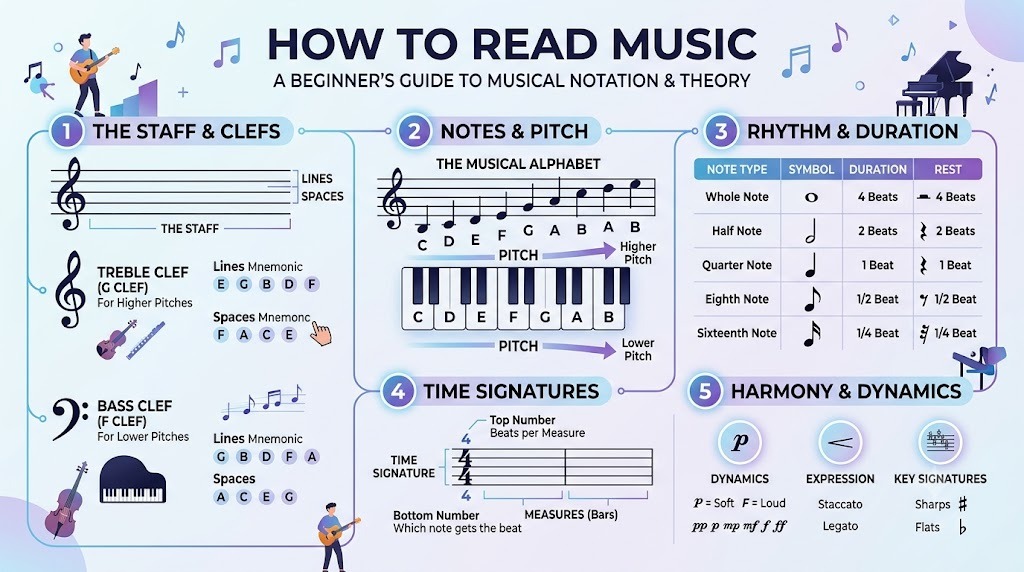
1. The Framework: Understanding the Staff & Clefs
The foundation of all western notation is the staff, a visual grid made of five parallel lines and four spaces. Think of it as a musical graph where higher placement equals a higher pitch. However, those lines mean nothing without a clef symbol at the beginning to act as a map legend.
Piano music uses a Grand Staff, which connects two staves together with a bracket. The top staff typically features the Treble Clef, also known as the G-Clef. The inner curl of this symbol circles the second line from the bottom, designating it as the note G. Instruments with higher registers, like the guitar and violin, use this clef.
The bottom staff uses the Bass Clef, or F-Clef. Its two dots surround the second line from the top, setting it as the note F. Cellos, bassoons, and a pianist’s left hand read from this clef. Knowing these anchor points is the first step, but how you process the remaining lines determines how fast you will eventually read.
2. Decoding Pitch: Moving Beyond the Alphabet Soup
Most beginners learn mnemonics like “Every Good Boy Does Fine” for treble lines or “FACE” for the spaces. While these help on day one, they are a massive developmental trap. If you have to recite a five-word phrase to identify a single note, you will never be able to play a song at tempo.
Instead, use the Landmark System. Memorize just three anchor notes across the Grand Staff: Middle C (the line between the two staves), Treble G, and Bass F. When you see a new note, do not calculate its exact letter name. Instead, identify its physical distance from your nearest landmark.
This approach is called reading by intervals. If a note is on a line, and the next note is on the space directly above it, that is a “step.” You simply move to the next adjacent key or fret. If the next note is on the next line up, that is a “skip.” You skip a key. You are reading the visual distance, not the letters.
Sometimes, notes drift higher or lower than the standard five lines. When this happens, composers use ledger lines. These are temporary, short lines drawn through or below a note head to extend the staff’s range.
3. Decoding Rhythm: Note Values & Timing
You can play the right pitch, but if the timing is wrong, it is the wrong note. Rhythm is the mathematical backbone of music. The shape of a note on the staff tells you exactly how long to hold it.
A note has up to three parts: a note head (empty or filled), a stem (the vertical line), and sometimes flags (tails attached to the stem). A whole note is an empty circle and receives four beats. Add a stem, and it becomes a half note worth two beats. Fill in the circle, and it is a quarter note worth one beat. Add a flag, and it becomes an eighth note worth half a beat. Silence is just as important, which is why every note value has a corresponding “rest” symbol indicating a pause.
Music is divided into small, manageable chunks called measures, which are separated by vertical bar lines. This grid keeps you from losing your place. At the start of the piece, right next to the clef, you will see a time signature like 4/4 or 3/4.
The top number tells you how many beats are in each measure. The bottom number tells you which type of note gets one beat (a 4 represents a quarter note). Therefore, 4/4 time means there are four quarter notes per measure. In 3/4 time, often used in waltzes, there are three quarter notes per measure.
4. The Roadmap: Key Signatures & Accidentals
Now that you understand pitch and rhythm, you need the scale rules for the specific song. Before the first note of a piece, you might see a cluster of sharp (#) or flat (b) symbols. This grouping is the key signature.
A sharp raises a pitch by one half-step (the very next key on a piano), while a flat lowers it. The key signature tells you which notes are automatically sharp or flat for the entire piece. If there is a sharp on the F line in the key signature, every F you play will be an F-sharp unless marked otherwise.
Occasionally, a composer wants to break the rules of the key signature. They will write an accidental—a sharp, flat, or natural symbol—directly next to a specific note. The golden rule here is the measure rule. An accidental only applies for the remainder of that specific measure. Once you cross the bar line into the next measure, the note reverts to the original key signature.
5. Bringing it to Life: Dynamics and Articulation
Playing correct pitches and rhythms will sound robotic without dynamics. Dynamics dictate volume and texture, turning mere typing into an expressive language.
You will commonly see Italian terms abbreviated beneath the staff. A p stands for piano (soft), while an f stands for forte (loud). You will also see hairpin symbols indicating a crescendo (gradually getting louder) or decrescendo (gradually getting softer).
Articulation marks tell you how to physically strike the note. A dot directly above or below a note head means staccato—play it short and detached. A curved line connecting multiple different notes is a slur, indicating legato—play them smoothly and deeply connected.
6. A Step-by-Step Problem-Solving Practice Routine
Understanding music theory is useless without a practical application system. When you sit down with a new piece of sheet music, follow this exact sequence to avoid cognitive overload.
Step 1: Rhythm First, Pitch Second. Put your instrument down. Clap the rhythm of the first measure while counting the beats out loud. If you cannot clap it accurately, you cannot play it. Separate the math from the mechanics.
Step 2: Isolate the Hands. If playing the piano, never start hands together. Learn the Treble Clef completely, then learn the Bass Clef completely. Your brain cannot process two new visual languages simultaneously.
Step 3: Micro-Chunking. Do not try to read an entire page at once. Read exactly one measure. Play it until it is flawless, then learn the second measure. Next, play measure one and two together. Link them like a chain.
Step 4: Keep Strict Time. Always practice with a metronome. Beginners often stop and stutter when they hit a wrong pitch, which destroys their internal sense of pulse. It is vastly better to play a wrong pitch in perfect time than a perfect pitch out of rhythm.