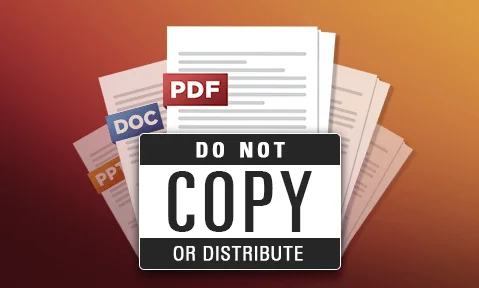

Stamping “Do Not Copy” across a confidential document feels like locking your front door: it signals intent, but it won’t stop anyone determined to get inside. Organizations spend time and money applying visible watermarks to PDFs, training materials, and financial reports, trusting that the label alone will deter misuse. The reality is far less reassuring. Without technical enforcement behind that warning, a watermark is just text on a page, and modern tools can strip it away in seconds. Understanding why “Do Not Copy” watermarks fail without DRM is the first step toward actually protecting sensitive content.
The False Security of Visual Deterrents
Psychological vs. Technical Protection
A visible watermark operates on a single assumption: that people will see the warning and choose to comply. This is psychological protection, not technical protection. It works the same way a “Please Keep Off the Grass” sign works: honest people respect it, and everyone else ignores it. In a corporate setting, the honest employees were never the threat to begin with. The real risk comes from disgruntled insiders, careless contractors, or external recipients who have no loyalty to your organization. A 2025 Ponemon Institute study found that 56% of data breaches involved some form of insider action, whether intentional or negligent. A text overlay does nothing to address either scenario.
Limitations of Static Overlay Labels
Static watermarks are baked into the visual layer of a document. They don’t interact with the operating system, the application rendering the file, or the user’s permissions. They can’t prevent someone from printing, forwarding, or editing the file. Think of it like writing “CONFIDENTIAL” on a piece of paper with a marker: the word is there, but the paper still photocopies just fine. The watermark might survive a copy, but the underlying content goes with it. Passing an audit because your documents display a warning label is not the same thing as actually preventing unauthorized distribution.
Common Methods for Bypassing Watermarks
AI-Powered Content-Aware Removal Tools
By 2026, AI-based image and document editing tools have made watermark removal trivially easy. Content-aware fill algorithms, originally designed for photo retouching, can detect repeating overlay patterns and reconstruct the background beneath them with startling accuracy. Free tools available online can process a batch of watermarked PDFs in minutes. The barrier to removal is essentially zero, which means your “Do Not Copy” label is a speed bump on a highway.
Cropping and Metadata Scrubbing
Even without sophisticated AI, a determined user can simply crop the watermarked area out of a document or screenshot. If the watermark sits in a corner or margin, a quick trim removes it entirely. Metadata scrubbing tools go a step further, wiping embedded author information, creation dates, and any hidden tags you might rely on for tracking. The result is a clean document with no trace of its origin, shared freely with no accountability.
Screen Capture and OCR Vulnerabilities
Screen capture remains one of the simplest and most overlooked attack vectors. A user opens your protected PDF, takes a screenshot, and pastes it into a new document. Optical character recognition software then converts the image back into editable text. The watermark disappears in the process, and the content lives on in a completely new file your organization can’t track or control. No amount of visual overlay survives this workflow.
How DRM Provides the Missing Enforcement Layer
Controlling Access and Viewing Permissions
DRM shifts protection from visual deterrence to technical enforcement. Instead of asking users not to copy, DRM makes copying impossible at the application level. Access controls determine who can open a document, on which devices, and for how long. A sales proposal sent to a prospective client can be locked to that client’s device, preventing them from forwarding it to a competitor. This is the fundamental difference: DRM doesn’t request compliance, it enforces it.
Preventing Unauthorized Redistribution and Printing
Strong DRM solutions disable print, copy, and paste functions within the viewing application itself. Even if a user wants to redistribute a document, the file is encrypted and bound to their credentials. Without valid authorization, the file is unreadable. Some platforms also block print-screen functionality and virtual printer drivers, closing the screen capture loophole that defeats traditional watermarks. The tradeoff here is a slight reduction in convenience for legitimate users, but for sensitive intellectual property, that tradeoff is well worth accepting.
The Synergy of Dynamic Watermarking and Encryption
User-Specific Identity Tracking
Static watermarks fail because they’re the same for every viewer. Dynamic watermarks solve this by embedding user-specific information, such as the viewer’s name, email address, or IP address, directly into the rendered document at view time. If someone does manage to capture the screen, the watermark identifies exactly who leaked the content. This creates a powerful deterrent backed by accountability rather than wishful thinking. Combined with encryption, dynamic watermarks become far harder to remove because they’re generated on the fly rather than stored as a static layer in the file.
Real-Time Revocation of Document Access
One of the most powerful DRM capabilities is remote revocation. If an employee leaves the company or a contract expires, you can instantly revoke their access to every protected document, even files already downloaded to their device. This is something no static watermark can ever accomplish. Real-time revocation means your protection adapts to changing circumstances, closing security gaps the moment they appear rather than after a breach has already occurred.
Implementing a Robust Content Protection Strategy
The pattern is clear: visual watermarks alone are a screen door on a submarine. They satisfy a surface-level desire for protection but crumble under any real pressure. A defense-in-depth approach pairs document-level encryption with dynamic watermarking, device binding, and granular permission controls. This combination addresses the full spectrum of threats, from casual negligence to deliberate exfiltration.
If you’re serious about protecting PDFs, training materials, ebooks, or sensitive reports from unauthorized copying and redistribution, Locklizard offers purpose-built DRM solutions that enforce your document use policies without relying on empty labels.