
ClickHouse has surged past $250 million in annual recurring revenue (ARR) with over 4,000 customers as of May 2026, tripling ARR year-over-year. At Open House 2026, the company launched Claude-powered Agents for agentic analytics, expanded Google Cloud integration, released key updates in version 26.5, and demonstrated superior cost-performance via CostBench benchmarks showing up to 23x advantages over competitors like Snowflake and Databricks.
What Is ClickHouse? Core Overview for 2026
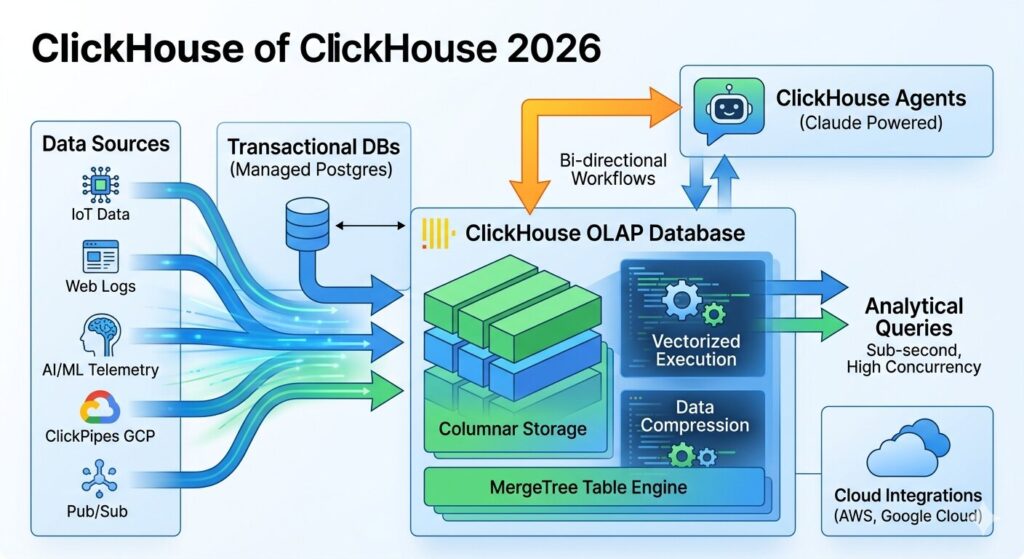
ClickHouse is an open-source, columnar OLAP database management system optimized for real-time analytical queries on massive datasets. It excels in high-ingestion scenarios, sub-second queries, and cost-efficient scaling, powering use cases from observability and AI/ML telemetry to business intelligence and lakehouse architectures.
Its architecture leverages vectorized execution, compression, and MergeTree table engines for unmatched speed on analytical workloads. In 2026, ClickHouse bridges transactional (via managed Postgres) and analytical needs while embracing agentic AI workflows.
Key 2026 Stats (as of Open House):
- ARR: >$250M (3x YoY)
- Customers: 4,000+ (1,000+ net new since Jan 2026)
- Notable Users: Anthropic, Meta, Tesla, Capital One, Visa, Shopify, and more.
Major ClickHouse News from Open House 2026
Record Growth and Business Momentum
ClickHouse’s momentum reflects the AI-driven demand for real-time, cost-effective data infrastructure. Post its $400M Series D in early 2026 (valuing thecompany at $15B earlier), growth accelerated with major enterprise wins.
Customer expansions include high-scale deployments at organizations requiring high-concurrency analytics for AI applications. The House Mates partner program launched with 25+ tech partners and 35+ services/consulting firms to accelerate ecosystem adoption.
ClickHouse Agents Powered by Claude
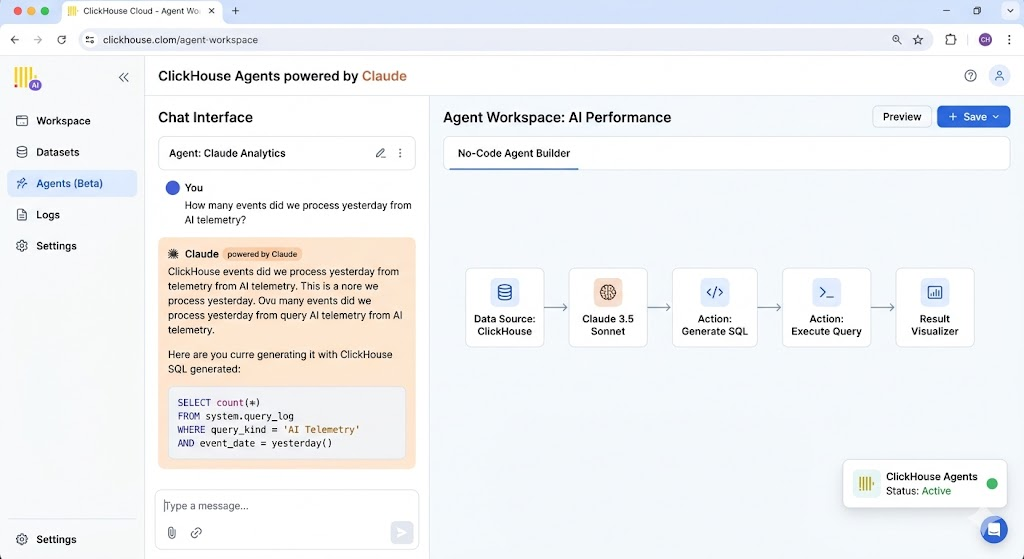
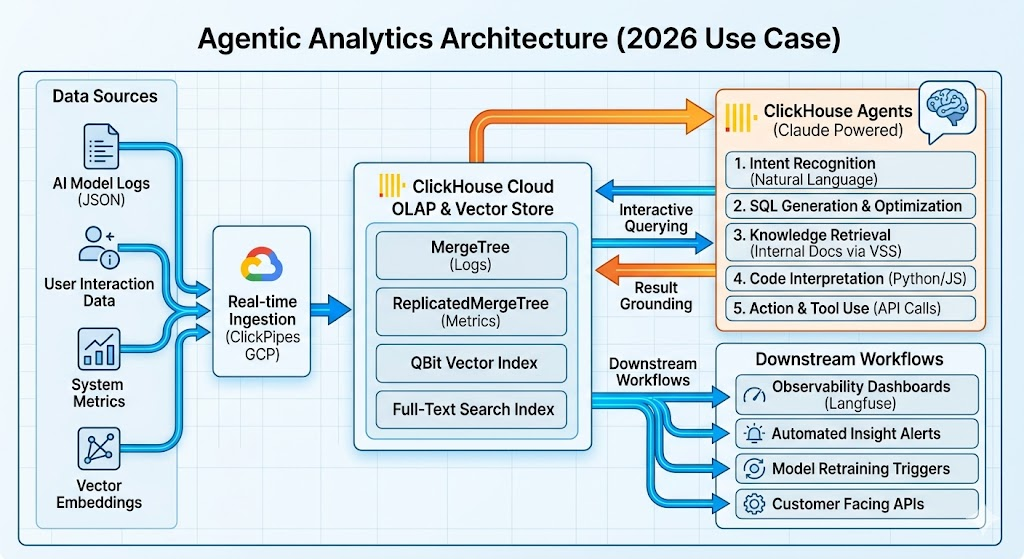
One of the headline announcements: ClickHouse Agents – a fully managed agentic analytics service in ClickHouse Cloud, powered by Anthropic’s Claude. It features a no-code builder, chat interface, sandboxed code interpreter, skills management, memory, and multi-agent workflows.
Agents connect natively to ClickHouse data and MCP-compatible systems, enabling bi-directional workflows. This addresses agent-driven query bursts (10-100x human volume) with sub-second responses on petabyte-scale data. Public beta includes integration with AWS Agent Registry and support for custom skills.
Why it matters: AI workloads demand a substrate that handles unpredictable, high-frequency queries without lock-in. ClickHouse Agents deliver transparency, control, and performance where closed platforms falter.
ClickHouse Release 26.5 Highlights (May 2026)
Release 26.5 brings numerous enhancements for performance, usability, and new capabilities:
- New Features:
max_bytes_ratio_before_external_joinfor better spill-to-disk handling; filesystem table function; support for bare function names in higher-order functions; tokenizeQuery and highlightQuery; negative values in LIMIT BY; expanded JSON functions; Paimon table engines; and more. - Performance: Improvements in joins, Parquet handling, and query execution.
- Backward Incompatibilities: Updated defaults for date/time parsing, HTTP limits, and more – review carefully for upgrades.
- Experimental: Web terminal interface.
Earlier 2026 releases (e.g., 26.3) introduced materialized CTEs, WebAssembly UDFs, and lightweight updates. Join performance improved 6x+ over the past year, matching or exceeding Snowflake/Databricks on TPC-H benchmarks.
Full changelogs are available in official docs, with monthly stable and LTS branches for production reliability.
Google Cloud Collaboration and Cloud Expansions
ClickHouse expanded its strategic partnership with Google Cloud, enhancing integration, flexibility, and performance for real-time analytics, data warehousing, observability, and AI/ML workloads.
Key updates include ClickPipes on GCP with Private Service Connect, Pub/Sub connector (private preview), cross-region replication, and agentic onboarding. Managed Postgres entered public beta, delivering 5x+ TPS over AWS RDS with seamless CDC to ClickHouse.
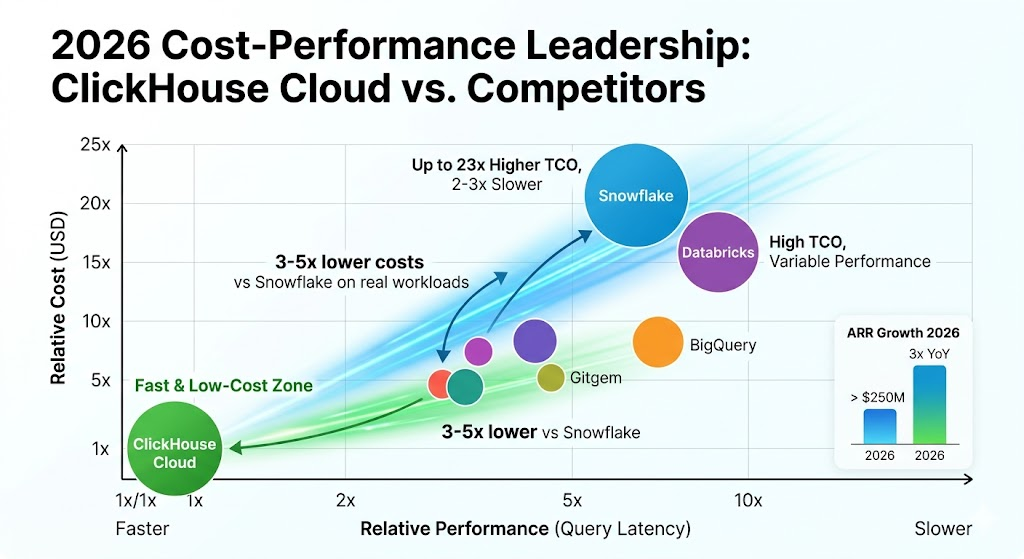
CostBench Benchmark: ClickHouse Cloud dominates cost-performance, staying in the “Fast & Low-Cost” zone while competitors lag by up to 23x. Independent tests show 2-3x faster queries and 3-5x lower costs vs. Snowflake on real workloads.
ClickHouse vs Competitors: 2026 Comparison
| Aspect | ClickHouse | Snowflake | BigQuery | Databricks |
| Query Speed | Sub-second, real-time | Strong but higher latency | Batch-oriented | Good for Spark workloads |
| Cost Efficiency | 3-23x better (CostBench) | Higher TCO | Usage-based, can spike | Variable |
| Real-Time Ingestion | Excellent | Limited | Batch-heavy | Good |
| AI/Agent Support | Native Claude Agents | Emerging | Integrations | ML-focused |
| Open Source | Fully open + Cloud | Proprietary | Proprietary | Open core |
| Joins & Complex Queries | 6x+ improved | Mature | Strong | Strong |
ClickHouse shines for high-volume, real-time, cost-sensitive workloads. Competitors excel in managed simplicity for some enterprise BI use cases.
People Also Ask: Common ClickHouse Questions in 2026
What is new in the latest ClickHouse release? Release 26.5 (May 2026) focuses on external join spilling, new table functions, JSON enhancements, and performance tuning. See official changelog for full details and upgrade guidance.
How does ClickHouse handle real-time updates? Lightweight updates (patch parts) deliver up to 1,000-2,400x faster performance than traditional mutations for high-frequency changes. Combined with ReplacingMergeTree, AggregatingMergeTree, and Postgres integration for hybrid OLTP/OLAP.
Is ClickHouse good for AI and agentic workloads? Yes. With vector search (QBit datatype), full-text search GA, Langfuse observability (200x query gains in V4), and Claude Agents, it’s purpose-built for AI telemetry, grounding, and agent-driven analytics.
ClickHouse Cloud pricing and self-hosted TCO? Cloud offers usage-based scaling with strong cost-performance. Self-hosted provides lower TCO at scale but requires ops expertise. Benchmarks show significant savings vs. alternatives at production volumes.
How to upgrade ClickHouse safely? Review changelogs, test in staging, use blue-green or rolling strategies. Cloud handles much of this automatically. LTS releases offer extended support.
Advanced Features and Best Practices
Performance Optimizations
- Joins: Multi-stage distributed execution, runtime filters, and reordering yield massive gains.
- Storage: Object storage integrations, Parquet improvements, and compression.
- Observability: Monitoring v2, ClickStack, Langfuse.
Schema and Query Best Practices
Choose optimal ORDER BY/primary keys, leverage materialized views, and use AI-assisted schema tools (coming). Avoid common pitfalls like excessive parts or unoptimized joins.
Use Cases in 2026
- Real-time dashboards and observability (e.g., logs at millions of events/min).
- AI model training telemetry and evaluation.
- Lakehouse interoperability with Paimon and others.
- SIEM, ad analytics, and financial systems.
Future Roadmap and Community
The 2026 roadmap emphasizes agent-native features, deeper lakehouse support, security/compliance, and global expansion. The open-source community drives rapid innovation, with frequent releases and contributions welcomed.
Events like Click-a-thon, training sessions, and Open House foster collaboration.
Conclusion: Why ClickHouse News Matters Now
ClickHouse’s 2026 trajectory—record revenue, AI agent integration, performance leadership, and ecosystem growth—positions it as the go-to real-time analytics engine for the AI era. Whether self-hosted or in Cloud, it delivers the speed, cost efficiency, and flexibility modern data teams demand.
Stay updated via official blog, docs, and GitHub. For production deployments, evaluate Cloud for managed ease or self-host for full control.