



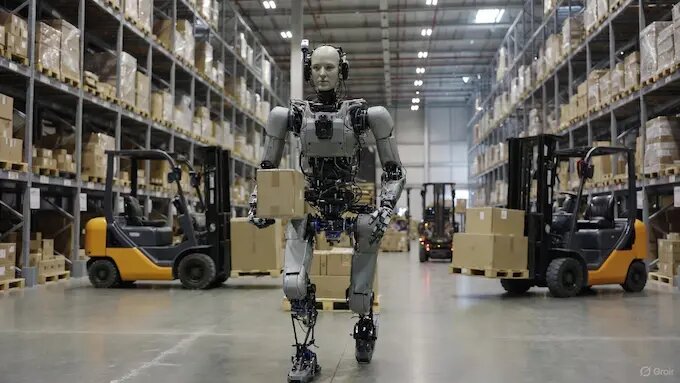

In 2026 according to Warehouse Robotics News, roughly 4.7 million warehouse robots run in over 50,000 facilities worldwide. The warehouse automation market stands at $30 billion and grows at an 18.7% CAGR toward $59.5 billion by 2030. Amazon operates nearly 1 million robots. DHL’s Locus AMRs just passed 1 billion picks. Agility Robotics’ Digit humanoid moved over 100,000 totes at GXO’s Flowery Branch site.
These numbers show real momentum. Labor turnover stays high. E-commerce volumes keep rising. Warehouses need faster, more flexible ways to move goods without adding headcount or space.

The New Factory Floor: How Autonomous Mobile Robots (AMRs) are Redefining Logistics and Warehousing – Aparobot Articles
MODEX 2026 starts April 13 in Atlanta. FANUC shows new AMRs and palletizing arms with AI vision. Quicktron debuts QuickBin Ultra and QuickCube pallet systems. Datalogic launches rugged mobile computers for operators.
These systems solve daily bottlenecks right now. No fluff. Just deployments that cut walking time, lower error rates, and scale without months of custom coding.
Latest Warehouse Robotics News Roundup (April 2026)
FANUC’s CRX-30iA mobile manipulator handles palletizing and depalletizing at high throughput. It works alongside humans and reduces physical strain.
DHL rolled out SVT Robotics’ SOFTBOT platform across 30 sites. It cuts deployment time by up to 12x compared with traditional integration. The company plans to reach 100 sites in three years.
Locus Robotics AMRs keep racking up picks at DHL. One unit recently completed the billionth pick in a single operation.
UPS automated 127 buildings and targets 68% of U.S. volume through automated sites by year-end. FedEx and others test similar trailer unloaders.
People Also Read : Dog with Robot: That Solve Real Pet Ownership Problems in 2026
How Top Players Solve Real Warehouse Problems
Amazon shifted from Blue Jay to modular Orbital systems for same-day delivery. Its fleet now uses DeepFleet AI to coordinate 1 million robots and cut congestion.
GXO uses Agility Digit to unload AMRs and load conveyors. The humanoid stacks totes when downstream stations back up. It runs 24/7 without breaks.
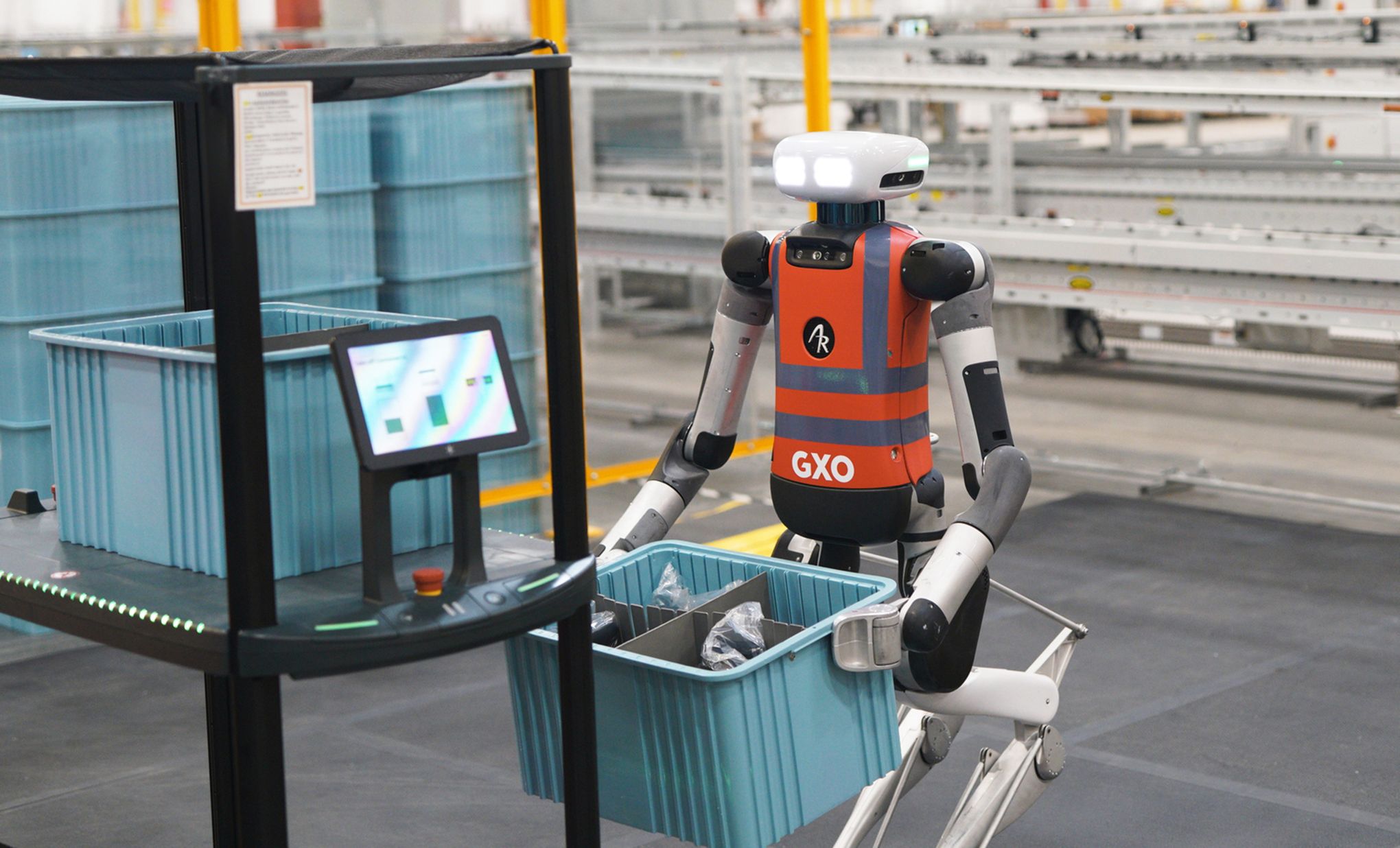
Meet Digit, the humanoid robot working in a Spanx warehouse | The Seattle Times
DHL pairs cobots with SOFTBOT for 650 cases per hour in unloading. The setup needs minimal reprogramming when layouts change.
Smaller operators turn to RaaS. Pay-per-pick models remove big upfront costs and let facilities test before scaling.
Key Innovations Tied to Specific Pain Points
Labor shortages hit hard. Humanoids like Digit and Boston Dynamics Atlas take repetitive tote handling. They cut walking by 75% and let staff focus on oversight.
Traffic jams slow everything. AI fleet software now gives right-of-way in real time. Digital twins let teams simulate changes before they hit the floor.
Picking accuracy improves with voice-integrated robots and computer vision. Error rates drop 90% in mixed-SKU environments.
Space stays tight. High-density AS/RS plus modular AMRs pack four times more product per square foot. Edge AI makes decisions without cloud delays.
Safety improves with autonomous sweepers and ultrasonic sensors. Predictive maintenance cuts unplanned downtime 30-40%.
Real ROI and Case Studies
Item-picking robots boost units per hour by 30%. Autonomous forklifts add similar gains.
RaaS users report 42% five-year OPEX reduction and eight-month payback in some cases.
One DHL site doubled productivity after AMR rollout. Netrush cut labor needs 75% with targeted automation.
| Metric | Traditional Warehouse | Robotics-Enabled Warehouse |
|---|---|---|
| Labor dependency | High | Reduced 30-75% |
| Picks per hour | Baseline | +30% |
| Error rate | Higher | -90% |
| Payback period | N/A | 8-36 months |
| Space utilization | Standard | Up to 4x density |
These results come from 2025-2026 deployments, not pilots.
Common Challenges and Proven Solutions
Integration with legacy systems trips up many teams. Start with a small pilot and use digital twins to map flows first.
ROI doubts linger when vendors overpromise. Stick to RaaS and open platforms. Track throughput, errors, and cost per pick from day one.
Cybersecurity and training matter. Edge AI keeps data local. Amazon-style upskilling programs retrain staff for robot oversight roles.
Peak-season reliability still worries operators. 2026 deployments now emphasize validated performance data over marketing claims.
Step-by-Step Implementation Guide for Warehouse Automation in 2026
Implementing robotics and AI-driven automation in your warehouse or fulfillment center has never been more accessible or cost-effective. With labor shortages, rising operational costs, and increasing order volumes, adopting Robotics-as-a-Service (RaaS), Autonomous Mobile Robots (AMRs), humanoid robots, and AI vision systems can transform your logistics operations in 2026.
Here’s a practical, proven step-by-step guide to help you successfully deploy warehouse automation while minimizing risk and maximizing ROI.
1. Conduct a Comprehensive Operational Audit
Start with a thorough assessment of your current warehouse performance. Analyze labor hours, peak volume periods, order processing times, congestion hotspots, and bottlenecks in picking, packing, sorting, and transport. Map out material flow, identify repetitive manual tasks, and calculate current throughput per worker. This data-driven audit helps you pinpoint exactly where automation will deliver the fastest impact and highest returns. Tools like warehouse management system (WMS) reports, time-motion studies, and IoT sensors can simplify this process.
2. Choose the Right Robotics-as-a-Service (RaaS) Solution
Opt for Robotics-as-a-Service (RaaS) models in 2026 to reduce upfront capital investment and test automation with minimal risk.
- Choose AMRs (Autonomous Mobile Robots) for efficient goods transport, towing, and point-to-point movement.
- Select Humanoid robots for more flexible, dexterous tasks such as picking irregular items, shelving, or handling complex assembly.
RaaS allows you to pay a monthly subscription that includes maintenance, software updates, and support — making advanced robotics accessible even for small and mid-sized warehouses.
3. Integrate AI Traffic Management and Vision Systems
In your pilot area, deploy AI-powered traffic orchestration software to coordinate multiple robots and avoid collisions while optimizing routes in real time. Combine this with advanced computer vision and AI recognition tools for accurate object detection, barcode reading, damage inspection, and inventory verification. These technologies enable seamless human-robot collaboration and dramatically improve accuracy and safety in dynamic warehouse environments.
4. Train Your Team for Hybrid Human-Robot Workflows
Successful automation requires people and robots working together. Provide comprehensive training programs so your staff learns how to supervise, collaborate with, and maintain robotic systems. Focus on new roles such as robot operators, fleet supervisors, and maintenance technicians. Emphasize safety protocols, exception handling, and how hybrid workflows increase productivity while reducing physical strain on employees.
5. Monitor Key Performance Indicators (KPIs) Weekly
Track your automation success with clear, measurable KPIs from day one:
- Throughput (orders processed per hour/day)
- Error rates and picking accuracy
- Downtime (robot and system availability)
- Labor productivity gains
- Cost per order
Weekly reviews allow you to quickly identify issues, optimize robot paths, refine AI models, and demonstrate ROI to stakeholders.
6. Scale Modularly After Achieving Payback
Once your pilot proves successful and reaches the target payback period (often 12–24 months with RaaS), expand automation in modular phases. Roll out additional robots and AI systems section by section — for example, starting with inbound receiving, then moving to picking zones, packing, and shipping. This phased approach reduces disruption and lets you continuously refine processes before full-scale deployment.
Ready to Future-Proof Your Warehouse in 2026?
By following this step-by-step robotics implementation guide, businesses can achieve 2–4x productivity gains, reduce labor dependency, and stay competitive in the fast-evolving logistics landscape.
Whether you’re exploring AMRs, humanoid robots, or full AI warehouse automation, starting with a smart audit and RaaS pilot is the lowest-risk path to success.
Would you like a customized checklist, cost estimation template, or vendor comparison for 2026 warehouse robotics? Let me know!
Future Outlook: 2026-2030 Trends
Humanoid prices should drop toward $20-30K. Full RaaS revenue could hit $34 billion.
AI world models will handle more variability. Energy-efficient designs cut power use in 24/7 ops.
Global networks like Cainiao expand robotic fulfillment. Over 60% of warehouses now budget extra for automation.
FAQs
How many robots does Amazon run in 2026? Nearly 1 million across its network.
Does robotics replace warehouse jobs? It shifts them. Staff move to higher-value tasks like oversight and exception handling. Total headcount often stays stable or grows with volume.
What delivers the fastest ROI? RaaS models with 8-18 month payback in proven deployments.
What happened with Amazon’s Blue Jay? The project ended after a few months. Tech lessons moved into newer modular systems.
Best entry point for SMEs? Start with one AMR fleet or RaaS cobot line. Measure before expanding.
Warehouse robotics news in 2026 is not about hype. It is about proven systems that cut costs, ease labor pressure, and handle growth. Audit one process this quarter. Pilot the right fix. The data shows the payback is real when you match the tech to your actual pain points.






[…] The key shift is practical adoption. Businesses and individuals are no longer asking if they should use AI. They are deciding how to use it effectively. […]
[…] ML Engineers: $200K–$400K+ total compensation […]
[…] To understand this better, you can explore the basics of Industrial automation. […]