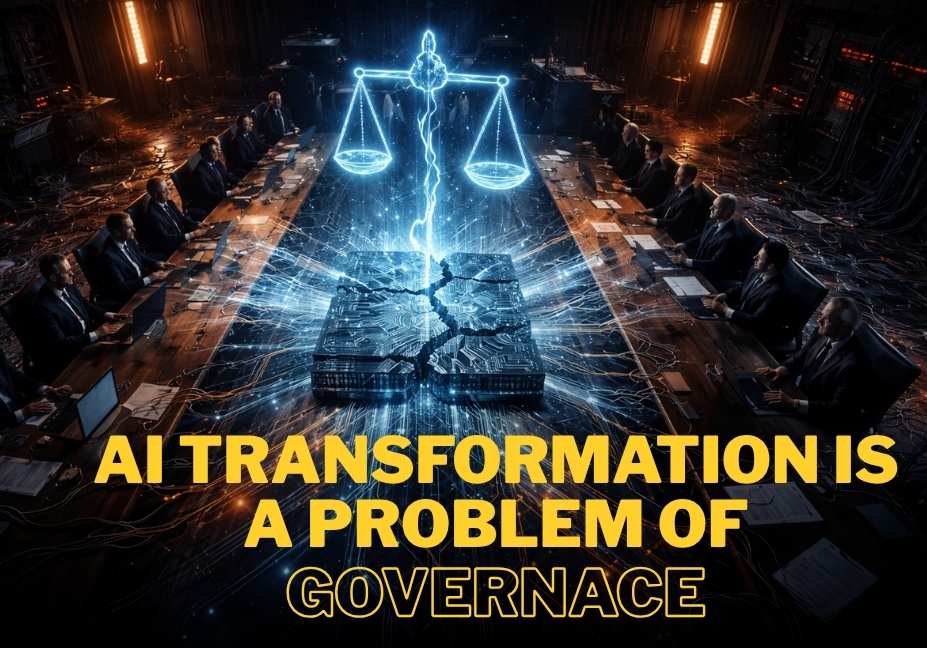

AI transformation fails when no one clearly owns decisions, risk, or accountability.
Most organizations already have capable models, tools, and data pipelines.
The real breakdown happens in governance—who approves, who monitors, and who is accountable when AI causes harm.
This is why companies see stalled deployments, compliance issues, or shadow AI usage.
Not because AI doesn’t work—but because governance systems are missing or weak.
And without governance, scaling AI means scaling risk.
The key shift is simple.
AI transformation is not a technology upgrade.
It is a governance redesign.

Where AI Transformations Actually Break
The first failure point is fragmented ownership.
AI projects often sit between IT, data science, and business teams.
No single owner controls the full lifecycle.
This leads to conflicting priorities.
Engineering pushes for speed.
Legal pushes for compliance.
Business teams push for outcomes.
Without defined decision rights, AI deployment slows or becomes risky.
And this is where governance becomes critical.
Another issue is uncontrolled model proliferation.
Teams deploy AI tools without approval.
This is often called “shadow AI.”
Recent industry estimates suggest that over 60% of employees use AI tools without formal approval in some organizations.
This creates security, privacy, and compliance risks that leadership cannot see.
The third failure point is incentives.
Teams are rewarded for shipping faster.
Not for managing risk or maintaining governance standards.
So even when governance policies exist, they are ignored.
This creates a gap between policy and practice.
Governance vs. Technology: The Real Constraint
Many companies try to fix AI problems by upgrading models.
But better models do not fix governance failures.
A highly accurate model can still produce biased outputs.
It can still violate privacy rules.
It can still be misused.
This is why governance matters more than raw performance.
Spending patterns confirm this imbalance.
Organizations invest heavily in AI tools and infrastructure.
But governance budgets—like audit systems and monitoring—remain limited.
This creates a structural gap.
AI capabilities grow faster than oversight.
And that gap becomes the main risk driver.
Core Governance Layers Required for AI Transformation
Effective AI governance operates across three layers.
Each layer solves a different problem.
Strategic Governance (Executive Level)
This layer defines risk appetite.
What AI use cases are acceptable?
What level of risk is tolerable?
Leadership must assign accountability here.
Without executive ownership, governance lacks authority.
This aligns closely with frameworks discussed in Artificial intelligence governance, where accountability and oversight are central principles.
Operational Governance (Cross-Functional Level)
This layer manages workflows.
How models are approved.
How risks are classified.
For example:
- Low-risk AI (internal automation) needs minimal oversight
- High-risk AI (customer decisions) needs strict review
Without this layer, teams operate in silos.
And governance becomes inconsistent.
Technical Governance (System Level)
This layer ensures control at scale.
It includes:
- Model versioning
- Monitoring systems
- Audit trails
This is where governance becomes enforceable.
Not just documented.
Decision Rights: Who Owns What in AI?
Clear ownership is the backbone of governance.
Every AI system needs defined roles:
- Who builds the model
- Who validates it
- Who approves deployment
- Who monitors outcomes
A simple RACI structure helps:
- Responsible: Data science team
- Accountable: Business owner
- Consulted: Legal, compliance
- Informed: Leadership
Without this clarity, decisions stall.
Or worse, they happen without accountability.
Governance Frameworks That Actually Work
Governance only works when it is operational.
Not theoretical.
Policy-Driven Deployment
AI systems should follow predefined rules.
For example:
- No deployment without risk classification
- Mandatory bias testing for customer-facing models
These rules must be enforced through systems.
Not just guidelines.
Risk-Tiered Model Management
Not all AI needs the same level of control.
A chatbot for internal use is low risk.
A credit scoring model is high risk.
Each category should have different governance requirements.
This prevents over-control and under-control.
Continuous Monitoring
Approval is not enough.
Models change over time.
Data drifts.
User behavior shifts.
Continuous monitoring detects:
- Performance drops
- Bias changes
- Unexpected usage
This turns governance into an ongoing process.

Regulatory Pressure Is Forcing Governance Maturity
Regulation is accelerating governance adoption.
Global frameworks now require:
- Transparency
- Auditability
- Risk classification
For example, AI systems must be explainable in many jurisdictions.
This is not a technical feature alone.
It is a governance requirement.
Failure to comply leads to penalties.
But more importantly, it damages trust.
This is why governance is becoming mandatory—not optional.
Practical Implementation Roadmap
Organizations can implement governance step by step.
Step 1: Audit Existing AI Systems
Identify all AI tools in use.
Including shadow AI.
Map:
- Purpose
- Risk level
- Ownership
This creates visibility.
Step 2: Define Governance Structure
Assign clear roles.
Create an AI oversight group.
Ensure representation from:
- Business
- Technology
- Compliance
This aligns decisions across teams.
Step 3: Implement Control Mechanisms
Introduce:
- Approval workflows
- Monitoring dashboards
- Audit logs
This makes governance enforceable.
Step 4: Align Incentives
Tie performance metrics to governance.
Reward:
- Safe deployment
- Compliance adherence
Penalize unmanaged AI usage.
This closes the gap between policy and behavior.
Common Mistakes to Avoid
Many organizations repeat the same governance mistakes.
Treating governance as documentation only.
Policies exist, but no enforcement.
Centralizing control without clarity.
This slows decisions without reducing risk.
Ignoring business accountability.
AI is treated as a technical issue, not a business one.
Delaying governance until scaling.
By then, risks are already embedded.
Key Takeaway
AI transformation succeeds when governance defines three things:
- Who makes decisions
- How risk is managed
- What controls are enforced
Without governance, AI does not fail immediately.
It fails at scale.
And when it fails, the cost is not technical.
It is organizational.
FAQ
Why is AI governance more important than model accuracy?
Because accurate models can still create legal and ethical risks without oversight.
What is the biggest governance risk?
Lack of visibility into AI systems, especially shadow deployments.
Can small teams implement governance?
Yes. Start with simple approval rules and ownership clarity.
This approach treats AI transformation as a control system problem.
And that is where most organizations need to focus next.