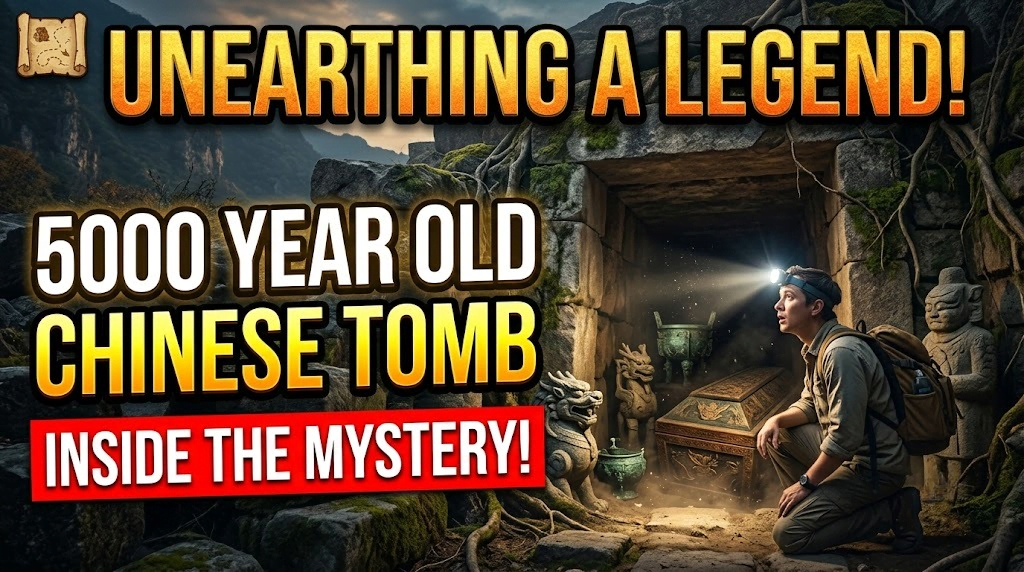

In the central Chinese province of Henan, archaeologists recently unearthed a 5000 year old chinese tomb burial site of unprecedented scale. Located within the Wangzhuang ruins in Yongcheng city, Tomb M27 spans more than 17 square meters. This massive Neolithic structure features both inner and outer wooden coffins, pointing directly to a prehistoric king. It provides hard evidence that Chinese civilization established complex state formations much earlier than previously confirmed.
The sheer volume of burial goods found inside this specific chamber is staggering. Excavators recovered over 350 individual artifacts, painting a vivid picture of ancient wealth. The haul includes more than 100 pieces of exquisite pottery and nearly 200 small, finely crafted jade ornaments. Additionally, researchers found numerous pig mandibles scattered throughout the site. Dating back to between 4000 B.C. and 2600 B.C., this site belongs to the middle and late periods of the Dawenkou culture.
Despite the immense wealth sealed inside, the tomb owner’s physical remains are almost entirely gone. Shortly after the burial took place 5,000 years ago, unknown individuals actively breached the chamber. They removed the ruler’s skeleton, leaving only a few stray toe bones behind. The intruders also scattered the jade ornaments and deliberately snapped the ceremonial stone blades in half.
At a Glance: Key Facts About the Prehistoric Tomb
If you are researching the latest findings from the Wangzhuang excavations, here are the hard facts. This quick summary cuts through the noise of competing archaeological news.
- Location: Wangzhuang ruins, Yongcheng City, Henan Province, central China.
- Age: Approximately 5,000 years old (spanning 4000 B.C. to 2600 B.C.).
- Culture: Middle and late periods of the Dawenkou Culture.
- Size: Over 17 square meters, which is exceptionally large for the Neolithic period.
- Significance: Widely believed to be the capital of a prehistoric kingdom, marking early state formation.
The Mystery: Why Was the Royal Tomb Intentionally Destroyed?
To understand the most compelling aspect of Tomb M27, we have to look at what is missing. The intentional destruction of the site reveals a darker side of prehistoric politics.
The evidence of desecration is highly specific and clearly targeted. Looters usually take valuables and leave the rest alone. Here, the intruders smashed the ceremonial stone blades with clear intent. They dragged the tomb owner’s body out of the heavy wooden coffins, leaving behind a few toe bones.
Archaeologists point out that this destruction happened shortly after the original burial. This timeline suggests the act was not random grave robbery. Current theories suggest a political or military rival destroyed the tomb. By erasing the physical remains and breaking the symbols of power, the rivals sought to wipe out the prehistoric king’s legacy entirely.
What Was Found Inside Tomb M27?
While the body was removed, the intruders left hundreds of artifacts behind. These remaining items provide a detailed look into the economic and social reality of the era. The presence of these goods proves the existence of highly specialized artisans.
Over 200 Jade Ornaments and Ceremonial Pottery
The structural design alone required immense labor, featuring both inner and outer wooden coffins. Surrounding these coffins, archaeologists cataloged over 350 artifacts.
The collection includes 100 pieces of distinct pottery and almost 200 small jade ornaments. Creating this much refined jade required a dedicated class of skilled craftsmen. This means the society produced enough surplus food to support artisans who did not farm. It is a clear marker of an advanced, structured economy.
Pig Mandibles and Prehistoric Wealth
You might wonder why pig bones matter in a royal tomb. In the Dawenkou culture, pigs were the ultimate currency. The inclusion of pig mandibles directly correlated with the tomb owner’s wealth and social status.
Across the Wangzhuang site, archaeologists noted that the larger the tomb, the more pig jaws it contained. This practice highlights a society obsessed with material wealth. It shows exactly how class stratification was enforced and displayed during the Neolithic age.
Who Was Buried in the Wangzhuang Tomb?
Based on the evidence, the occupant of M27 was not simply a wealthy merchant or elder. Researchers classify this individual as a prehistoric king.
Before this period, Dawenkou burials were relatively egalitarian, with most people receiving similar grave sizes and goods. Tomb M27 shatters that mold completely. The sheer scale of a 17-square-meter chamber required a massive, coordinated workforce.
The concentration of imported goods and high-status symbols proves a dramatic shift in human history. Society had moved away from equal farming communities into a strict social hierarchy governed by an elite ruling class. This site was likely the central capital of an early state, ruled by an absolute monarch.
Evidence of a Prehistoric “Cultural Melting Pot”
For decades, textbooks taught that Chinese civilization grew from a single point in the Yellow River valley. The Wangzhuang ruins completely rewrite this outdated narrative.
Inside the tomb, researchers found a strange mix of regional burial customs. The site features eastern Dawenkou practices, such as burying water deer teeth and deliberately deforming occipital bones. However, the pottery includes small-mouthed, pointed-bottom jars native to the Yangshao culture from central China.
This intersection of styles proves that early Chinese cultures were highly connected. They traded goods, shared religious practices, and integrated deeply with one another. Ancient China was a complex network of interacting societies rather than an isolated monolith.
Clarification: The Hongshan Jade Dragon Tomb Discovery
If you are following archaeological news, you might feel confused by recent headlines. Around the exact same time as the Wangzhuang excavation, researchers announced another 5,000-year-old discovery.
This second site is located in Chifeng City, Inner Mongolia. It belongs to the Hongshan Culture, which existed far to the north of the Dawenkou. At the Yuanbaoshan site, archaeologists uncovered a massive stone mound tomb. Inside, they found a stunning 15.8-centimeter jade dragon, the largest of its kind ever discovered.
It is crucial to distinguish between the two ancient sites. The Wangzhuang tomb in Henan gives us a destroyed royal chamber and a cultural melting pot of central cultures. The Chifeng tomb in Inner Mongolia provides unprecedented insight into the ritualistic jade usage of the northern Hongshan people. Both discoveries are currently reshaping our understanding of the Neolithic world, but they represent entirely different ancient kingdoms.