



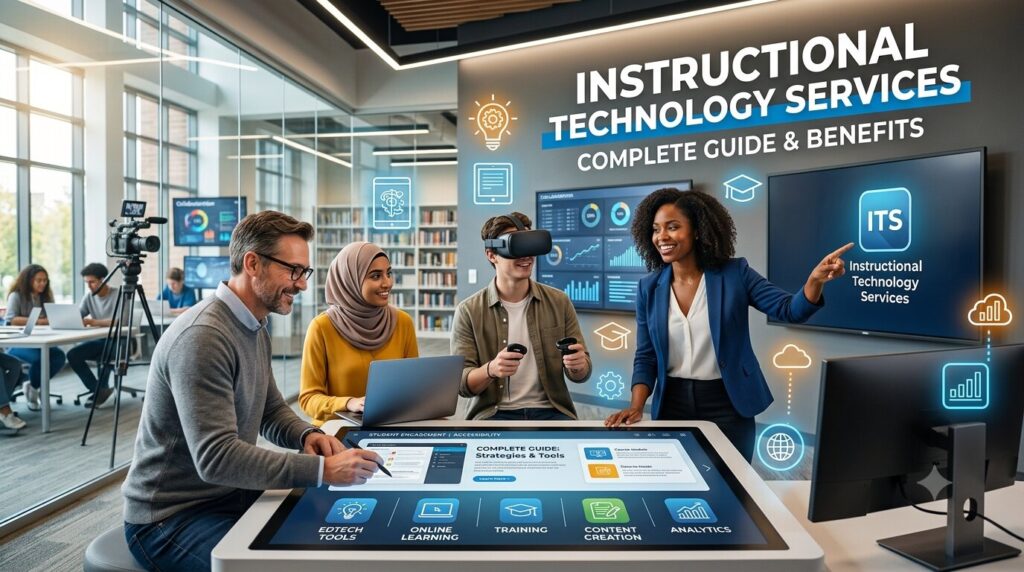

Instructional technology services are professional offerings that help educators and organizations design, integrate, and manage digital tools — including learning management systems, multimedia content, assessment platforms, and AI-driven learning analytics — to improve teaching effectiveness and learner outcomes. They are used to make instruction more engaging, data-informed, and scalable.
Whether you’re a district administrator modernizing curriculum delivery, a university dean rethinking hybrid programs, or a corporate L&D leader designing upskilling initiatives, understanding how these services work — and how to choose the right model — is now a foundational competency rather than a nice-to-have.
This guide walks through the full landscape: the learning-science case for ed-tech integration, the major service models available today, the practical steps for deployment, and the compliance and maintenance practices that protect both learners and institutions over the long term.

Section 1: The Benefits — Learning Science & Engagement Impact
How the Brain Responds to Interactive, Multimodal Instruction
Decades of cognitive research point in the same direction: the brain engages differently — and more durably — with instruction that requires active participation than with instruction delivered passively. When a learner only listens to a lecture, encoding is shallow and easily lost. When that same learner interacts with content — answering embedded questions, manipulating a simulation, narrating a process back in their own words — multiple memory systems activate at once.
Two principles explain why this matters for instructional design. Active recall strengthens memory far more effectively than re-reading or passive review; the act of retrieving information, even imperfectly, reinforces the neural pathways tied to that knowledge. Digital platforms make active recall practical at scale through low-stakes quizzing, spaced retrieval prompts, and adaptive practice sets that resurface concepts right before they would otherwise be forgotten.
Dual-coding theory adds a second layer: learners retain information better when it’s presented through both verbal and visual channels simultaneously rather than text alone. A well-designed digital lesson pairs narrated explanation with diagrams, annotated video, or interactive models — giving the brain two complementary pathways to the same idea instead of one. This is precisely the kind of multimodal delivery that instructional technology services are built to produce and manage at scale, something static handouts or unstructured slide decks cannot replicate consistently across hundreds of classrooms or course sections.
Interactive stimuli — branching scenarios, real-time polling, gamified practice — also sustain attention longer than passive delivery, particularly for younger learners and for adult professionals squeezing training into a busy workday. The result isn’t just “more engagement” in an abstract sense; it’s measurably better encoding of the material being taught.
Reducing Friction in Curriculum Delivery
Beyond pedagogy, instructional technology services solve a very practical problem: friction. Manual grading consumes enormous instructor time that could otherwise go toward individualized support. Fragmented tools — one platform for video, another for assessment, a third for grade reporting — create inconsistent learner experiences and force instructors into constant context-switching. Inconsistent content quality across sections or campuses erodes both learning outcomes and institutional reputation.
A coordinated instructional technology service layer addresses all three issues simultaneously: automated and semi-automated grading frees instructor time, integrated platforms eliminate tool-switching, and centrally managed content libraries ensure every learner — regardless of section, campus, or cohort — receives material of consistent quality.
Supporting Equity and Accessibility at Scale
The broader shift toward blended and digital-first learning isn’t a temporary pandemic-era artifact; it’s now a permanent feature of how institutions operate. This shift carries real equity implications. Done well, instructional technology lets a rural school district offer the same advanced coursework as a well-resourced suburban one, gives a working adult learner asynchronous access to a degree program they couldn’t otherwise attend, and provides built-in accommodations — captions, screen-reader compatibility, adjustable pacing — that support learners with diverse needs by default rather than as an afterthought.
Measurable Outcomes
Institutions that move from fragmented, non-integrated teaching tools to a coordinated instructional technology approach consistently report stronger retention rates and more measurable learning outcomes. The reason is straightforward: integrated systems generate data — completion rates, item-level performance, time-on-task — that traditional classroom instruction simply doesn’t produce. That data closes the loop between teaching and improvement in a way lecture-and-textbook models cannot. For a deeper dive into the cognitive mechanisms behind these results, see
“The Science of Digital Learning Engagement.”
Section 2: Types of Instructional Technology Service Models
Not every institution needs — or can afford — the same level of service. Four general models dominate the market today, each suited to different organizational maturity levels and budgets.
1. Standalone Tool Implementation. This is the entry point: a single platform, most often a learning management system (LMS), deployed with minimal customization. It’s fast to stand up and inexpensive, but it leaves curriculum design, content quality, and instructor training largely up to individual departments or teachers. Useful for small programs or early pilots, but it tends to plateau quickly at scale.
2. Integrated Curriculum Design Services. Here, custom instructional content is built specifically to align with the chosen platform’s capabilities — interactive assessments mapped to learning objectives, multimedia lessons designed around the LMS’s native tools, and content sequencing aligned to a defined curriculum map. This model produces a noticeably more cohesive learner experience than a standalone tool used “as-is.”
3. Role-Based Instructional Support. Recognizing that a K-12 classroom, a university lecture hall, and a corporate training session have fundamentally different needs, this model differentiates support by audience. K-12 deployments emphasize classroom management integrations and parental communication; higher-ed deployments emphasize academic integrity tools and LMS-to-registrar integrations; corporate L&D deployments emphasize compliance tracking, certification pathways, and integration with HR systems.
4. Managed Learning Ecosystems. This is full-service: an ongoing technology-and-pedagogy partnership in which the provider manages platform updates, curriculum refreshes, instructor training, and learner-analytics dashboards continuously rather than as a one-time project.
Why Managed Learning Ecosystems Are the Gold Standard
For institution-wide deployments, Managed Learning Ecosystems represent the gold standard. Rather than treating technology and curriculum as separate, occasionally-updated projects, this model keeps both in continuous alignment. The practical advantages compound over time:
 Real-time content updates mean curriculum stays current without requiring a full re-implementation cycle each year.
 Centralized administrator dashboards give leadership a single view across every classroom, course, or training cohort — instead of stitching together exports from disconnected tools.
 Analytics-integrated learner progress tracking flows continuously from the classroom level up to the institutional level, enabling early intervention for struggling learners and evidence-based decisions about what content or pacing to adjust.

Instructional Design & Analytics Dashboard
Gives school districts, universities, and corporate training teams a single source of truth for pedagogical consistency — tracking which content is working, where learners are stalling, and where instructor support is most needed — turning what used to be guesswork into an evidence-based practice.

Digital Learning Support Suite
For organizations ready to commit to the full model, the Digital Learning Support Suite functions as the definitive end-to-end instructional technology solution — spanning classroom deployments, hybrid programs, and enterprise upskilling initiatives under one coordinated system rather than a patchwork of point solutions.
If your institution currently operates under a Standalone or Role-Based model, the path toward a Managed Ecosystem typically starts with platform onboarding.

Section 3: Deployment & Configuration
A strong service model means little without a disciplined rollout. Institutions that struggle with ed-tech adoption almost always trace the problem back to deployment, not the technology itself.
The Golden Implementation Framework
A well-run rollout follows a few consistent benchmarks:
- Staff-to-technologist support ratios. Sustained adoption tends to require roughly one instructional technologist for every 25–40 educators during the active rollout phase, scaling down to a smaller ongoing support ratio once the platform reaches steady-state use. Stretching support too thin during the first semester is the single most common cause of stalled adoption.
- Platform onboarding timelines. A phased timeline — pilot group in month one, department-wide rollout by month three, full institutional adoption by month six — consistently outperforms attempts to deploy everywhere simultaneously. Phasing surfaces configuration issues while the stakes are still low.
- Content readiness benchmarks. Before broad rollout, core curriculum content should be fully migrated and quality-checked, not just “available.” A common failure mode is launching a platform technically on schedule while the content inside it is only 60–70% ready, which undermines instructor confidence in the first weeks when it matters most.
Environment Considerations
Technical readiness matters just as much as pedagogical readiness:
 Infrastructure. Confirm available bandwidth can support simultaneous video streaming and interactive content across the expected concurrent user load, and verify device access — whether through a 1:1 program, shared carts, or BYOD policies — before assuming universal access.
 Accessibility compliance. Platforms and content should meet WCAG standards and reflect Universal Design for Learning (UDL) principles from the outset, rather than retrofitting accommodations after launch. This includes captioning, screen-reader compatibility, and flexible pacing options built into the base design.
 Cross-platform compatibility. Learners and instructors should be able to move seamlessly between iOS, Android, and desktop environments without needing specialized technical training — a platform that only “really works” on one device type will quietly suppress adoption among learners who don’t have access to that device.
For detailed technical specifications on bandwidth planning, device provisioning, and accessibility configuration.
Section 4: Safety, Compliance & Maintenance
Data Privacy & Security
Any instructional technology deployment that touches student data carries legal and ethical obligations that can’t be an afterthought. In the United States, this means designing systems and workflows around FERPA (Family Educational Rights and Privacy Act) and, for platforms used by younger learners, COPPA (Children’s Online Privacy Protection Act) compliance from day one — not retrofitted after a vendor contract is signed.
Practical best practices include:
- Establishing clear consent and parental-notification mechanisms before collecting any data from minors, including transparent disclosure of what data is collected and how it will be used.
- Limiting data collection to what’s pedagogically necessary, rather than defaulting to maximal data capture because a platform technically allows it.
- Ensuring learner data is encrypted both in transit and at rest, with access controls that restrict visibility to only the staff who need it for legitimate educational purposes.
- Conducting periodic vendor audits to confirm that third-party tools integrated into your ecosystem maintain the same compliance standards as your core platform.
These obligations only grow more complex as ecosystems scale and incorporate more third-party integrations, which is why many institutions formalize this into ongoing governance rather than a one-time checklist. For a full breakdown of FERPA/COPPA obligations and recommended consent workflows, see
“Instructional Technology Data Privacy & Compliance Guide.”
Keeping Technology and Content Current
The second half of compliance is less about law and more about quality control: keeping software, integrations, and content current. Outdated software versions create security vulnerabilities and compatibility failures. Broken integrations — a grading tool that silently stops syncing with the LMS, for instance — can go unnoticed for weeks while quietly corrupting the data administrators rely on for decision-making. Stale curriculum content erodes both learning outcomes and institutional credibility, particularly in fast-moving fields where last year’s material may already be outdated.
This is precisely the maintenance burden that Managed Learning Ecosystems are designed to absorb. Rather than relying on individual departments to notice and report problems, a managed service continuously monitors platform health, refreshes content on a defined cycle, and flags compliance issues before they become incidents — turning maintenance from a reactive scramble into a predictable, ongoing process.
See On Wikipedia

Bringing It All Together
- Instructional technology services sit at the intersection of learning science, systems integration, and institutional governance. The benefits are well established: better-encoded learning through active, multimodal instruction; less administrative friction; broader equity and accessibility; and measurable gains in retention and outcomes. The right service model — whether a focused standalone tool or a full Managed Learning Ecosystem — depends on institutional scale and ambition, but the data consistently favors integrated, continuously maintained systems over fragmented, ad hoc tooling.
- Deployment success comes down to discipline: realistic support ratios, phased timelines, genuine content readiness, and infrastructure planning that accounts for the full diversity of devices and learners an institution actually serves. And none of it holds up without rigorous, ongoing attention to data privacy and platform maintenance — the unglamorous work that protects both learners and institutional credibility over time.
- For institutions ready to move from a patchwork of disconnected tools toward a coordinated, evidence-based approach, the path typically runs through a strong Instructional Design & Analytics Dashboard for pedagogical consistency, supported by a comprehensive system like the Digital Learning Support Suite to manage the full lifecycle — from classroom rollout to enterprise-wide upskilling — under one coherent, well-maintained ecosystem.






[…] 22Jun2026 AI Technology Instructional Technology Services: Complete Guide & Benefits AI Technology Instructional Technology Data Privacy & Compliance […]
[…] 22Jun2026 AI Technology Instructional Technology Services: Complete Guide & Benefits AI Technology Instructional Technology Data Privacy & Compliance […]