




Pillar Guide · Near-Field Communication
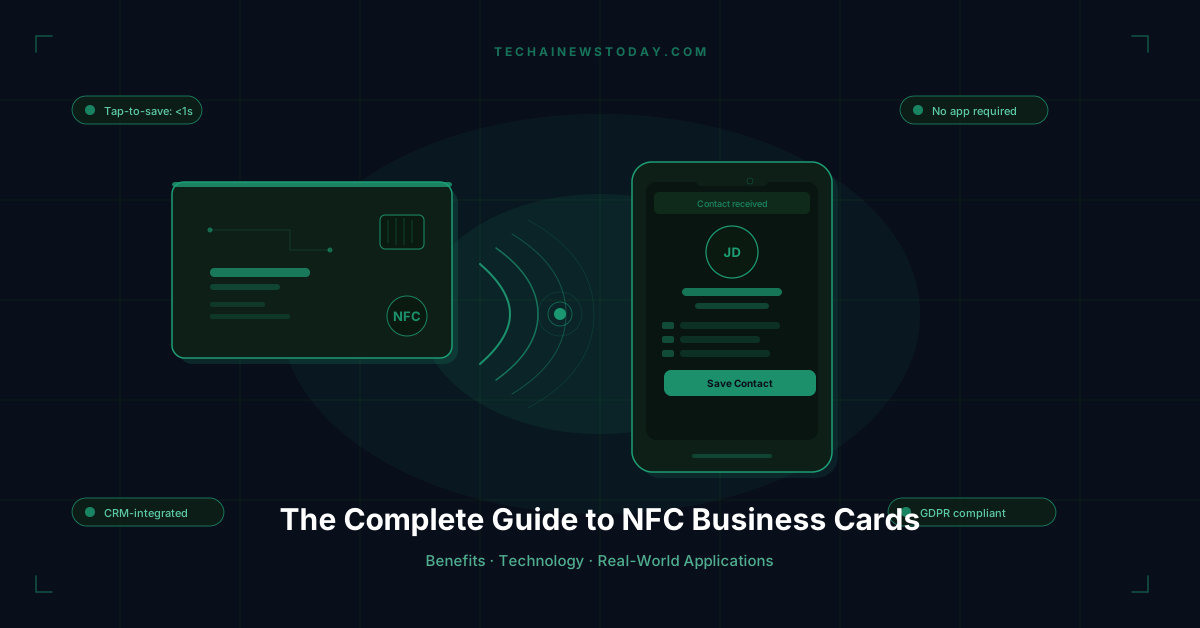
NFC business cards are smart contact-sharing tools embedded with a near-field communication chip that wirelessly transmits your professional information — including contact details, portfolio links, social profiles, and booking pages — to any smartphone with a single tap. They are used to make networking faster, more memorable, and fully trackable.
The Benefits — Behavioral Science & First-Impression Impact
The way a first impression is encoded in memory depends less on what information is exchanged and more on how that exchange feels. Neuroscience calls this the novelty response: when the brain encounters an unexpected, seamless interaction — a single tap triggering an instant digital handoff — it flags the experience as significant and allocates disproportionate memory resources to it. This is why recipients of NFC cards consistently recall the person behind them more vividly than those who received a traditional paper alternative.
The “wow effect” is not superficial — it is a measurable neurological event. Interactive stimuli processed through touch activate sensory memory pathways that static visual inputs (a paper card) do not reach. The result: NFC card exchanges are remembered longer, associated more positively, and more likely to trigger follow-up action.
Beyond psychology, the practical friction reduction is transformative. Traditional business card exchanges demand a chain of error-prone manual steps: physical card retained, contact data typed into a phone, typos corrected, duplicate entries resolved. Each step is a drop-off point. NFC eliminates every one of them. The recipient’s phone receives a clean, pre-formatted contact record in under one second — no app required, no abbreviations to decode.
The environmental case is equally compelling. A mid-size sales organization of 50 representatives printing and re-printing paper cards at industry-standard intervals generates tens of thousands of discarded cards annually — a measurable print and chemical waste liability. NFC cards are a durable, one-time physical production with unlimited digital updates. For organizations committed to ESG reporting, the elimination of recurring print waste across an entire networking team is a concrete, auditable contribution to sustainability goals.
Finally, consider follow-up behavior. Studies in sales conversion consistently show that the quality of the first touchpoint predicts the likelihood of a second. Because an NFC tap delivers a contact directly into the recipient’s digital ecosystem — appearing in their recents, ready to message or email — the time-to-follow-up window shrinks dramatically. The card that required manual entry sits on a desk. The digital contact is already in the pocket.
Types of NFC Business Card Experiences
Not all NFC cards are created equal. The difference between a basic implementation and an enterprise-grade deployment is substantial — in capability, flexibility, and return on investment. Understanding the four primary categories helps organizations select the right tier for their use case.
Standard NFC Cards
A single static link encoded at the point of manufacture. Tapping the card redirects to one fixed URL — typically a vCard download or a basic landing page. No editing possible post-production. Suitable for individuals with stable contact information and a single professional identity.
Dynamic NFC Cards
The chip stores a redirect URL that can be updated at any time via an online dashboard. Change jobs, rebrand, or update your portfolio — the card’s physical form stays the same while the digital destination evolves. A significant upgrade for professionals in transitional roles or frequent rebranders.
Multi-Profile NFC Cards
Context-aware cards that can switch between distinct professional profiles — investor relations vs. sales, personal brand vs. corporate identity — based on role or tapping environment. Ideal for founders, consultants, and professionals who operate across multiple audiences simultaneously.
Gold Standard
NFC-Enabled Smart Badges
Enterprise wearable formats for events, conferences, and integrated team deployments. Combines dynamic linking with CRM integration, team management dashboards, and real-time analytics. The definitive format for organizations running structured business development programs.
Why Dynamic Multi-Profile NFC Cards are the enterprise gold standard: they enable real-time profile updates without card reprinting, support team management dashboards for brand consistency enforcement, and provide CRM-integrated lead capture that ties every tap to a pipeline record. For sales organizations, this transforms every handshake into a tracked, attributable business development event.
For enterprise deployment, the critical question is not which card looks best — it is which platform gives administrators the controls they need. A distributed sales team tapping cards at dozens of simultaneous events produces meaningless data without centralized management. The right NFC solution provides a single pane of glass: team profiles, tap analytics, lead export, and brand compliance controls in one dashboard.
Deployment & Configuration — The Golden Setup Ratio
Deploying an NFC card is not a one-step action. The gap between a card that consistently converts taps into saved contacts and one that frustrates recipients lies in three measurable variables: chip read range, redirect speed, and profile completeness. Together, these form what practitioners call the Golden Setup Ratio.
The Golden Setup Ratio — Target Benchmarks
3–5 cm
<400 ms
≥7 fields
App-free
A chip read range of 3 to 5 centimeters is optimal: close enough to feel intentional and secure, but forgiving enough to work through standard card holders and cases. Redirect speeds below 400 milliseconds prevent the recipient’s phone from appearing unresponsive — a delay that disproportionately undermines the professional impression the card is designed to create.
Profile completeness — defined as a minimum of seven populated fields — is the single highest-leverage variable for post-tap conversion. Cards linking to sparse profiles see significantly lower save-to-contact rates than those delivering a rich digital identity: name, role, company, mobile, email, website, and at least one social or booking link.
Material selection matters more than aesthetics alone. The card substrate directly affects chip performance, environmental durability, and brand alignment.
A critical note on metal cards: their conductive substrate requires the NFC chip to be placed at the card’s outer edge or center-bottom zone to prevent signal interference. A metal card with a centrally placed chip will fail to read reliably. Always confirm chip placement specifications with your supplier before production.
Compatibility across iOS (iPhone 7 and later, NFC-native) and Android (NFC-enabled, comprising the vast majority of current Android flagship and mid-range devices) is non-negotiable for professional deployment. The best NFC implementations require no app installation on the recipient’s device — the tap triggers the phone’s native NFC reader, and the profile opens in the device’s default browser or contacts app instantly.
Safety, Compliance & Maintenance
The capability that makes NFC cards powerful — the ability to capture contact interactions at scale and feed them into CRM systems — is precisely what creates compliance obligations. Any organization collecting personal data via NFC taps from contacts in the European Union or California must treat that data as a regulated asset from the moment of first capture.
Critical: Data Privacy & GDPR/CCPA Compliance
Every NFC tap that captures a recipient’s device identifier, location signal, or pre-filled contact data constitutes data collection under GDPR and CCPA. Your NFC platform must provide: (1) a clearly visible consent prompt before data is stored, (2) a data retention policy communicated to recipients, (3) a documented right-to-deletion workflow, and (4) encrypted storage for all collected lead data. Failure to implement these mechanisms exposes organizations to regulatory fines and reputational damage. For comprehensive compliance architecture, consult the NFC Business Card Security & Privacy Guide.
Beyond legal compliance, there is a practical professional credibility dimension to card maintenance that is consistently underestimated. A dynamic NFC card linking to a defunct landing page, a role you no longer hold, or an email address that bounces delivers a precise message to the recipient: this professional does not maintain attention to detail. In high-stakes business development contexts, that impression is often irrecoverable.
Establish a quarterly profile audit cadence as a minimum standard. For enterprise deployments, the NFC Team Management Dashboard should be configured with profile completeness alerts that notify administrators when any team member’s profile drops below the organization’s minimum field threshold or contains broken links. Treat your NFC profile with the same diligence you would apply to your LinkedIn presence or company website — it is an always-on digital representative.
Recommended maintenance schedule: Monthly — verify all destination URLs resolve correctly. Quarterly — review profile completeness against current role and offerings. Annually — assess whether the card’s linked platform still meets organizational compliance and feature requirements. Upon any role change — update profile within 24 hours of the transition.
Featured Solutions
Enterprise Productivity
NFC Team Management Dashboard
The centralized command layer for organizations deploying NFC cards at scale. Enables brand consistency enforcement, real-time profile oversight, and performance analytics across distributed sales and networking teams — whether in-office, remote, or hybrid.
Centralized profile management for unlimited team members
Brand template enforcement — no off-brand profiles reach the field
Tap analytics by team member, region, and event
Automated profile completeness alerts and compliance flags
Role-based access controls for marketing and HR administrators
Event & Conference
NFC Smart Lead Capture Suite
The definitive contactless networking solution for high-velocity environments: trade shows, conferences, investor summits, and enterprise business development events. Transforms every tap into a structured, CRM-ready lead record in real time.
Instant CRM push — leads appear in Salesforce, HubSpot, or custom CRM on tap
Consent-first capture with GDPR/CCPA-compliant opt-in flow
Offline-capable tap logging — syncs when connectivity resumes
Lead scoring and event-level attribution reporting
NFC Smart Badge integration for event wearable deployments
This pillar guide reflects NFC technology standards and enterprise deployment best practices current as of 2025–2026. Regulatory guidance references GDPR (EU 2016/679) and CCPA (California Civil Code §1798.100 et seq.). Always consult qualified legal counsel for jurisdiction-specific compliance implementation.





[…] People Also Read : The Complete Guide to NFC Business Cards […]