





Starlink serves over 10.6 million subscribers across 159 countries as of March 2026.
Its top competitors deliver real options today. Amazon Leo rolls out consumer service mid-2026. OneWeb focuses on enterprise reliability with 648 operational satellites. Viasat and HughesNet provide lower-cost GEO plans for fixed rural spots.
These alternatives fix common Starlink headaches: $349–$599 hardware, peak-hour throttling in busy areas, and higher monthly fees once congestion hits.
Amazon Leo aims for 400 Mbps downloads with low latency and smaller terminals.
OneWeb guarantees dedicated bandwidth and 99.5% uptime SLAs for businesses.
Viasat and HughesNet cut total yearly costs by $200–$400 for users who skip gaming or video calls.
Pick the right one and you save money while keeping usable speeds.
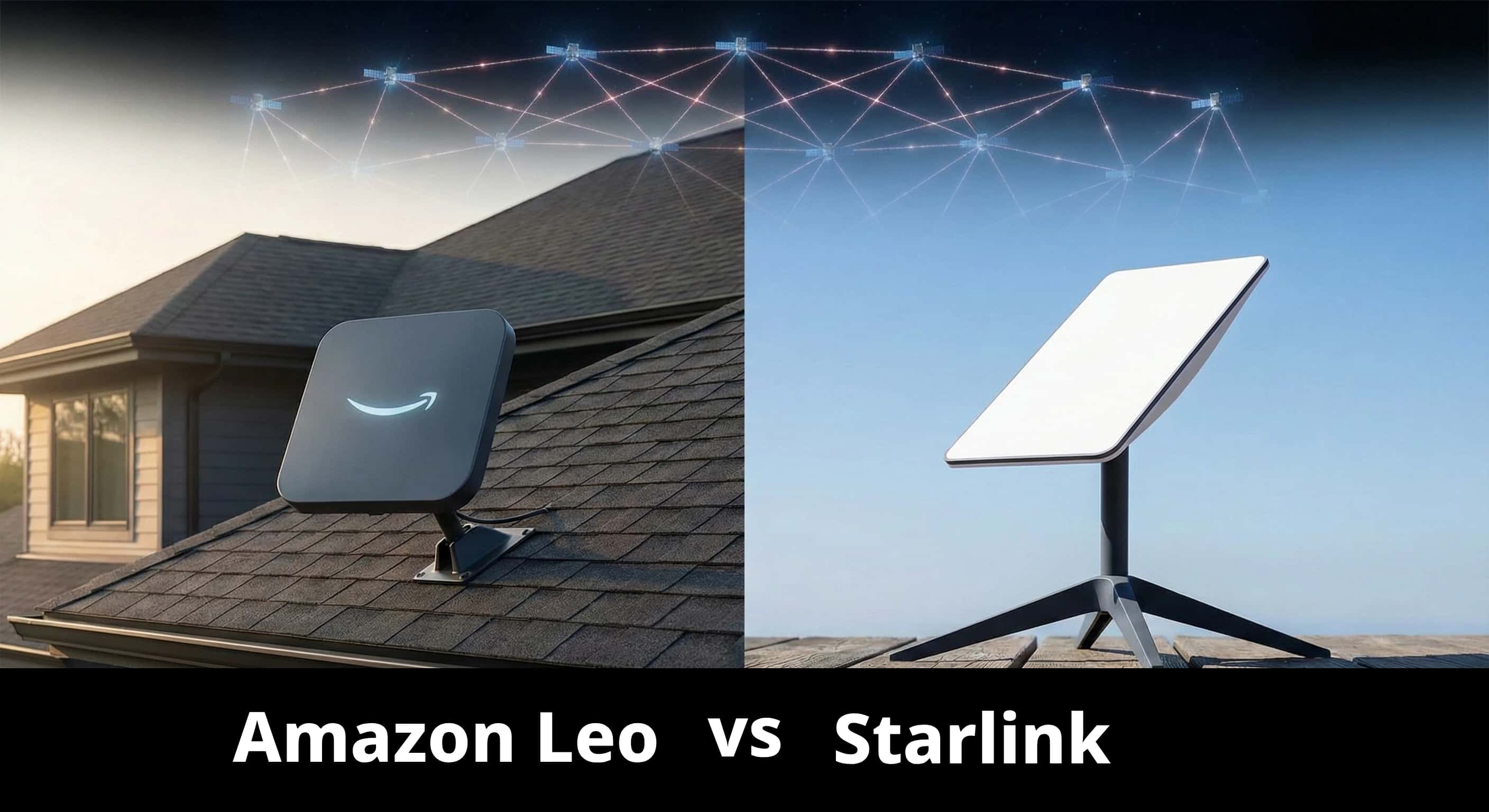
Amazon Leo vs. Starlink: The 2025 Satellite Internet Battle
Amazon Leo terminal (left) next to a Starlink dish. Leo’s design is smaller and targets lower upfront costs.
Key Comparison Factors That Matter in 2026
Latency decides gaming and Zoom quality. Starlink hits 20–50 ms. OneWeb runs 70–100 ms. Viasat and HughesNet sit at 450–700 ms—fine for email and streaming but not real-time work.
Speeds vary by orbit. LEO networks (Starlink, Leo, OneWeb) deliver 50–350 Mbps. GEO networks (Viasat, HughesNet) top out at 25–150 Mbps but stay more consistent during peak hours.
Pricing includes hardware. Starlink residential starts near $120 per month in the US. Viasat plans begin at $70–$100 with softer data policies. HughesNet offers $50–$95 intro rates but often locks you into a 2-year contract.
Coverage gaps still exist. Starlink covers poles and oceans best. OneWeb shines in high-latitude maritime routes. GEO providers focus on continental rural zones and skip true global mobility.
Amazon Leo – The Closest LEO Match Launching Mid-2026
Amazon Leo (rebranded from Project Kuiper) begins consumer rollout mid-2026 after enterprise beta testing.
It plans 3,236 LEO satellites for global reach. Early projections show 400 Mbps downloads and latency close to Starlink’s range. Terminals measure roughly 12 inches wide—smaller than Starlink’s Standard dish.
Pricing details remain limited, but Amazon signals affordability to undercut Starlink hardware costs. Early aviation deals with Delta and JetBlue point to strong enterprise integration via AWS.
Best for: Early adopters, AWS users, or households wanting future-proof LEO without Starlink’s current waitlists in high-demand zones.
Drawback: Full availability lags Starlink by several months in many countries.
OneWeb – Enterprise Reliability Over Raw Speed
OneWeb (now Eutelsat OneWeb) operates 648 satellites at 1,200 km altitude.
It delivers 50–200 Mbps with symmetrical uploads and dedicated bandwidth options. Latency stays steady at 70–100 ms. Partners provide 99.5% uptime SLAs—something Starlink rarely guarantees for consumer plans.
No direct-to-consumer sales. You buy through resellers for maritime, aviation, or business use. Hardware costs more upfront but includes professional installation and service-level agreements.
Best for: Boats, planes, or companies that lose money when internet drops. Polar coverage matches Starlink well.
Viasat – Unlimited Data Value for Non-Gaming Homes
Viasat-3 powers 25–150 Mbps downloads with 450–700 ms latency. Plans run $70–$150 per month with soft caps up to 850 GB before slowdowns.
Equipment often costs $250–$300 or less with promotions. Many bundles include professional install. No hard data caps on top “Unleashed” tiers.
Best for: Heavy downloaders in fixed rural homes who stream Netflix but skip competitive gaming. Long-term costs beat Starlink for steady, predictable use.
HughesNet – Budget Rural Pick with Fusion Hybrid Plans
HughesNet Jupiter 3 delivers 25–100 Mbps and ~600 ms latency. Plans start at $50–$95 per month with 100–200 GB soft caps.
Two-year contracts are common, but median real-world speeds hold steady. Fusion hybrid adds 5G backup in select areas.
Best for: Price-sensitive fixed locations where basic browsing and email matter most. Lower total ownership cost than Starlink for light users.
Quick 2026 Comparison Table
| Provider | Orbit | Download Speeds | Latency | Monthly Price (US) | Hardware Cost | Data Policy | Best For |
|---|---|---|---|---|---|---|---|
| Starlink | LEO | 100–350 Mbps | 20–50 ms | $120 | $349–$599 | Unlimited (deprioritized) | Mobile, gaming, global |
| Amazon Leo | LEO | Up to 400 Mbps | <60 ms | TBA (affordable) | Lower projected | Unlimited | Future homes, AWS users |
| OneWeb | LEO | 50–200 Mbps | 70–100 ms | Enterprise only | Higher (reseller) | Dedicated options | Business, maritime |
| Viasat | GEO | 25–150 Mbps | 450–700 ms | $70–$150 | $250–$300 | Soft cap 850 GB | Budget rural streaming |
| HughesNet | GEO | 25–100 Mbps | ~600 ms | $50–$120 | $300–$450 | Soft cap 100–200 GB | Lowest-cost fixed use |
Data drawn from provider reports and independent tests as of early 2026.

MIT study compares the four largest internet meganetworks | MIT News | Massachusetts Institute of Technology
Orbital coverage comparison (SpaceX/Starlink, OneWeb, and others). LEO constellations fill gaps that GEO misses.
Which Competitor Solves Your Exact Problem?
Rural home on a tight budget? Go Viasat or HughesNet. You save hundreds yearly without needing low latency.
RV or boat user? Starlink Mini still leads, but OneWeb maritime terminals offer stronger SLAs as backup.
Business needing uptime guarantees? OneWeb or future Telesat Lightspeed beats consumer Starlink.
Waiting for cheaper hardware? Amazon Leo mid-2026 launch could drop terminal prices across the board.
International or polar routes? OneWeb and Starlink tie; avoid GEO entirely.
2026–2027 Outlook
Amazon Leo scales quickly after mid-year launch and pressures Starlink pricing. AST SpaceMobile adds direct-to-cell (no dish) intermittent US service early 2026. Regulatory deadlines push faster deployment across all players.
Hybrid setups—satellite plus fixed wireless—become common for reliability.
Actionable Next Steps
- Check availability maps for your exact address.
- Calculate 12-month total cost (hardware + monthly + install).
- Test current speeds with a 30-day trial where offered.
- Read recent user reports on congestion in your area.
- Contact sales for business SLAs if uptime matters.
Starlink still dominates scale and speed for most mobile users. Yet 2026 gives real choice. Match the competitor to your location, budget, and usage and you get faster, cheaper, or more reliable internet without guesswork.
FAQs
Is Amazon Leo available now? Enterprise beta yes. Full consumer mid-2026.
How does OneWeb latency compare to Starlink? OneWeb runs 70–100 ms. Starlink stays lower at 20–50 ms.
Which offers the cheapest unlimited satellite in 2026? Viasat or HughesNet for non-real-time use. Starlink wins only when you need low latency.
Can I switch without downtime? Yes—order the new service first, test it, then cancel the old one.
Wikipedia reference for deeper reading: Amazon Leo.
Starlink changed rural internet forever. Its competitors now give you options that fit your exact needs in 2026. Use the specs, table, and decision guide above to pick the right one and stop overpaying or dealing with unreliable service.






[…] Orphan pages […]