



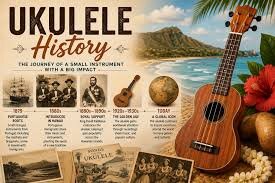

The ukulele is a small, four-stringed instrument that originated in the 1880s when Portuguese immigrants brought their machete and rajão instruments to Hawaii. Hawaiians adapted these designs into a new instrument they called the “ukulele.” It is celebrated for its bright, cheerful sound and its deep ties to Hawaiian culture. This guide traces that journey, from royal courts to modern stages.

Section 1: The Origins — Cultural Roots & Early Adoption
Every great instrument has a birthplace. For the ukulele, that birthplace is Hawaii, but its roots reach across the Atlantic to Portugal.
Portuguese Craftsmen and the First Ukuleles
In 1879, a ship called the Ravenscrag arrived in Honolulu. It carried laborers from Madeira and the Azores, islands off the coast of Portugal. Among them were skilled woodworkers. These craftsmen brought small, guitar-like instruments called the machete and the rajão. Both instruments were compact. Both had bright, percussive tones.
Three names stand above the rest in this origin story: Manuel Nunes, Augusto Dias, and Jose do Espirito Santo. These three luthiers are widely credited as the founding fathers of the modern ukulele. They refined the machete’s design. They adjusted its body shape. They experimented with tuning until a distinct new instrument emerged.
The result was lighter than a guitar. It was easier to hold. Its sound was sweeter and more portable than its Portuguese ancestors. Hawaiians gave it a name that has stuck for over a century: “ukulele,” often translated as “jumping flea,” a playful nod to the quick movement of a player’s fingers across the strings.

Royal Endorsement: King Kalākaua’s Influence
No instrument becomes a cultural icon by accident. Royal support helped seal the ukulele’s fate.
King Kalākaua, Hawaii’s last reigning king, was a passionate patron of the arts. He worked to revive Hawaiian traditions during a period of intense Western influence. He embraced the ukulele as part of that revival. He featured it in royal performances. He encouraged its use alongside traditional Hawaiian chants and dance.
This royal endorsement mattered enormously. It transformed the ukulele from a novelty import into a legitimate symbol of Hawaiian identity. When a king plays an instrument, a nation listens. The ukulele’s association with royalty gave it instant cultural credibility, something that newer instruments rarely achieve so quickly.
Hula, Music, and Island Identity
The ukulele did not rise alone. It rose alongside hula.
Hula performances had long relied on chants and percussion. By the early 20th century, the ukulele had become a natural companion to these dances. Its bright tone complemented vocal melodies. Its rhythmic strumming patterns supported dancers’ movements.
Musicians began composing original Hawaiian songs specifically for ukulele accompaniment. These songs blended traditional melodic structures with the instrument’s playful character. The pairing of hula and ukulele cemented the instrument as more than music. It became a marker of place, of pride, and of island identity.
The 1915 Panama-Pacific International Exposition
The ukulele’s leap to mainland fame can be traced to a single event: the 1915 Panama-Pacific International Exposition in San Francisco.
Hawaii built an elaborate pavilion for the exposition. Hawaiian musicians performed there daily. Visitors heard the ukulele’s distinctive sound for the first time. Many were captivated.
A craze followed almost immediately. Sheet music companies rushed to publish ukulele arrangements. Mainland manufacturers began producing their own versions of the instrument. Vaudeville performers picked it up. By the 1920s, the ukulele had become a fixture of American popular culture, appearing in films, on Tin Pan Alley records, and in countless living rooms.
This first wave of mainland popularity proved foundational. Without the 1915 exposition, the ukulele’s global journey might have unfolded very differently.
For a deeper look at how these musical traditions shaped the islands more broadly, see our guide on The Cultural Legacy of Hawaiian Music.

Section 2: Types of Ukuleles
Not all ukuleles sound alike. Size changes everything. Four main types dominate the modern market: Soprano, Concert, Tenor, and Baritone.
Soprano Ukulele
The Soprano is the original size. It is the smallest of the four. Its scale length typically measures around 13 inches. Its sound is bright, plucky, and instantly recognizable as “the” classic ukulele tone.
Beginners often start here. The Soprano is affordable. It is lightweight. It travels easily. However, its compact fretboard can feel cramped for players with larger hands or those exploring advanced fingerstyle techniques.
Concert Ukulele
The Concert ukulele was developed to address the Soprano’s limitations. Its body is slightly larger. Its neck is a touch longer. The result is a fuller, slightly warmer tone with noticeably more volume.
Many intermediate players prefer the Concert. The added space between frets makes complex chords more comfortable. The slightly bigger body produces richer overtones, without sacrificing the ukulele’s signature brightness.
Tenor Ukulele
The Tenor ukulele goes a step further. It features a longer neck and a deeper, more resonant body. Its tone leans warmer and rounder than the Soprano or Concert.
Tenor ukuleles are popular among performing musicians. Their increased volume projects well on stage. Their wider fretboard spacing supports advanced techniques like fingerpicking, slides, and complex chord voicings.
Baritone Ukulele
The Baritone is the largest standard ukulele size. Its tuning differs from the other three. Soprano, Concert, and Tenor ukuleles are typically tuned G-C-E-A. The Baritone, by contrast, is tuned D-G-B-E, the same as the top four strings of a standard guitar.
This tuning makes the Baritone the closest relative to the guitar in both tone and feel. Guitarists transitioning to ukulele often find the Baritone the easiest entry point.

Why Concert and Tenor Are the “Gold Standard”
Among serious players, Concert and Tenor ukuleles are frequently considered the gold standard. Why? Three reasons stand out.
First, portability remains strong. Neither size becomes unwieldy, unlike larger stringed instruments. Second, projection improves significantly over the Soprano, making these sizes suitable for performance settings. Third, fretboard spacing is more generous. This comfort matters greatly for intermediate and advanced techniques, including barre chords, fast strumming patterns, and intricate fingerstyle arrangements.
For players ready to grow beyond beginner basics, Concert and Tenor models typically offer the best balance of comfort, tone, and versatility.

Section 3: Evolution & Construction
Behind every great-sounding ukulele lies careful engineering. Construction choices shape tone as much as size does.
The “Golden Build Ratio”
Luthiers often speak of a “Golden Build Ratio” when designing ukuleles. This ratio refers to the optimal relationship between body size, neck length, and string tension.
A well-balanced ukulele typically maintains a body-to-neck ratio that allows for comfortable reach without sacrificing resonant body volume. String tension benchmarks matter too. Tension that is too low produces a thin, buzzy sound. Tension that is too high can warp the neck over time or strain the top wood.
Tonewood selection plays a critical role as well. Wood density, grain direction, and thickness all affect how sound waves travel through the body, directly shaping the instrument’s resonance and sustain.
Tonewood Choices: Koa vs. Mahogany, Spruce, and Laminates
Traditional Hawaiian ukuleles are built from koa wood. Koa is native to Hawaii. It is prized for its warm, balanced tone and beautiful golden-brown grain. Vintage koa instruments remain highly sought after by collectors and historians alike.
Mahogany offers a different character. It tends to produce a slightly darker, more bass-forward tone. It is also more widely available than koa, making it a popular choice for modern manufacturers.
Spruce, often used for soundboards rather than entire bodies, brings a brighter, more articulate top end. It is frequently paired with mahogany or rosewood for the back and sides.
Laminate alternatives have grown common in recent decades. Laminate ukuleles are built from layered wood veneers rather than solid pieces. They are generally more affordable and more resistant to humidity changes, although tonal complexity is often reduced compared to solid-wood instruments.
Soundhole Placement and Bracing
Tone is shaped by more than wood alone. Soundhole placement affects how air resonates within the body cavity. Traditional round soundholes remain standard, though some modern luthiers experiment with offset or alternative shapes to alter projection.
Internal bracing is equally important. Bracing patterns reinforce the top and back of the instrument while still allowing it to vibrate freely. Lighter bracing tends to produce louder, more resonant tones, while heavier bracing can add durability at the cost of some tonal openness. These principles apply across both acoustic and electric-acoustic models, though electric-acoustic ukuleles add pickups and preamps that introduce additional tonal variables.
For readers interested in hands-on building advice, our Ukulele Craftsmanship & Tonewood Guide offers detailed, practical guidance.

Section 4: Cultural Revivals & Preservation
The ukulele’s story is not finished. Today, careful stewardship is required to protect both the instrument’s craftsmanship and its history.
Authenticity & Craftsmanship
Traditional Hawaiian luthier techniques deserve protection. These techniques were developed and refined by generations of craftsmen, beginning with Nunes, Dias, and do Espirito Santo. As global demand for ukuleles grows, mass production sometimes threatens these traditional methods.
Sustainable tonewood sourcing has become an urgent concern as well. Koa, in particular, grows slowly and exists in limited supply. Responsible sourcing practices help ensure that future generations of luthiers can continue working with this culturally significant wood.
Vintage instrument preservation also matters greatly. Older ukuleles, especially early Hawaiian-made models, are fragile cultural artifacts. Best practices include controlling humidity, avoiding direct sunlight, and seeking specialized repair rather than amateur restoration. Collectors and museums alike share responsibility for protecting these pieces of musical history.
Our Vintage Ukulele Identification Guide serves as a definitive resource for collectors, historians, and enthusiasts researching authentic instruments.
Why Accurate History Matters
Historical accuracy is not a minor detail. It is essential.
Misattributed origins can erase the contributions of the very communities who created this instrument. Oversimplified narratives sometimes credit “Hawaii” alone, overlooking the Portuguese craftsmen whose machete and rajão instruments made the ukulele possible in the first place. At other times, Hawaiian innovation is downplayed, reducing a rich cultural story to a footnote.
These erasures cause real harm. Cultural understanding suffers when origin stories are flattened or distorted. Respecting both Portuguese and Hawaiian contributions ensures that the ukulele’s history is told with the nuance and accuracy it deserves.
According to Wikipedia, the ukulele generally has four strings, and the name has been said to mean “jumping flea,” possibly because of the movement of the player’s fingers. For readers who want to explore the instrument’s documented history in even greater depth, Wikipedia’s ukulele entry offers a thorough starting point.

Your Next Steps: Learning and Collecting
Whether you are picking up a ukulele for the first time or researching a vintage instrument for your collection, dedicated resources can accelerate your progress.
Beginners, hobbyists, and music educators alike will benefit from a structured Ukulele Player’s Learning Roadmap. A good roadmap typically moves from basic chord shapes, through strumming patterns, and into fingerstyle techniques, mirroring the instrument’s own historical journey from simple folk accompaniment to sophisticated solo performance.
Collectors, historians, and researchers will find equal value in a dedicated Vintage Ukulele Identification Guide. Identifying authentic early Hawaiian-made instruments requires careful attention to wood grain, label markings, bracing patterns, and construction techniques, many of which trace directly back to the original Portuguese-Hawaiian luthiers discussed in this guide.

Conclusion
The ukulele’s history spans continents, royal courts, world fairs, and modern recording studios. It began with Portuguese craftsmen and their machete instruments. It was elevated by Hawaiian royalty and woven into hula traditions. It conquered mainland America at a single exposition in 1915. Today, it remains one of the most accessible, beloved instruments in the world.
Understanding this history honors everyone involved in its creation. Portuguese immigrants, Hawaiian royalty, and generations of skilled luthiers all share credit for the small, four-stringed instrument now played and loved across the globe. As the ukulele continues evolving, preserving this complete and accurate story remains essential, ensuring that its cultural roots are never lost amid its modern popularity.






[…] Theft Auto VI officially launches worldwide on November 19, 2026, for PlayStation 5 and Xbox Series X/S. The game introduces dual protagonists, […]